Last updated: October 2, 2026
Quick Answer
An electric school bus costs roughly three times a diesel one. District records put real orders between $359,691 and $432,560 per bus. The technology now works, the grid will pay some of it back, and the policy that was supposed to force the change just moved five years to the right.
- Electric buses list at $300,000 to $440,000. Diesel lists at $98,000 to $154,000.
- Vehicle-to-grid programs grew from 15 utilities to 26 across 19 states in two years. Districts earn about $6,000 to $9,000 per bus per year where the programs are mature.
- New York moved its purchase mandate to July 2032, not the 2027 still widely reported, and full operation to 2040.
- Blue Bird delivered 355 electric buses in one quarter and holds more than 770 in backlog.
- Lion Electric collapsed. Close to 2,000 buses in service lost their warranty coverage, which is now a live procurement risk.
What does an electric school bus cost?
Between $300,000 and $440,000 depending on size, according to price bands collected in a 2025 GAO review of diesel bus alternatives from World Resources Institute research. A comparable diesel bus runs $98,000 to $154,000.
Actual orders sit at the top of that band, and sometimes above it.
| District | What they bought | Price per bus | Funding noted |
|---|---|---|---|
| Hazel Park School District, MI | 4 electric buses | $394,308 | Clean Bus Energy Grant |
| Jamul-Dulzura Union SD, CA | 2 IC Bus CE electric Type C | $432,507 | ZESBI award |
| First Student, MT | 2 IC Bus PB11E electric | $432,560 | Montana Clean Truck and Bus Round 3 |
| Oregon district | 2 Type A electric buses | $359,691 | Sourcewell contract plus utility grant |
| Washington County Schools, TN | Blue Bird electric bus | $439,960 total package | Grant with local capital match |
Source: Civic IQ purchase records and board agendas, September 2025 to August 2026.
Every one of those orders carries grant money. That is not a coincidence. Strip the grant out and most of these purchases do not clear a board vote.
The all-in number is higher still, because a bus needs somewhere to charge. Bakersfield City School District approved $17,000,000 for 32 electric buses and the infrastructure to run them. That works out near $531,000 per bus once chargers and site work are counted. The district separately committed to buy those 32 buses by December 31, 2029 under an agreement with its utility.
Charging alone is a real line item. Downey Unified paid $158,561 for four DC fast charging stations, or about $39,600 each, to support its zero emission bus project.
The range question
Blue Bird rates its Vision and All American electric buses at 77 to 84 passengers and up to 120 miles on a charge. That covers most routes and not all of them. A district running long rural routes, or two tiers of routes on one bus, has to plan around it.
Battery sizes in the V2G pilots give a sense of scale. Buses in these programs carry 150 to 180 kWh packs, paired with 60 kW chargers.
What the grid pays back: vehicle-to-grid
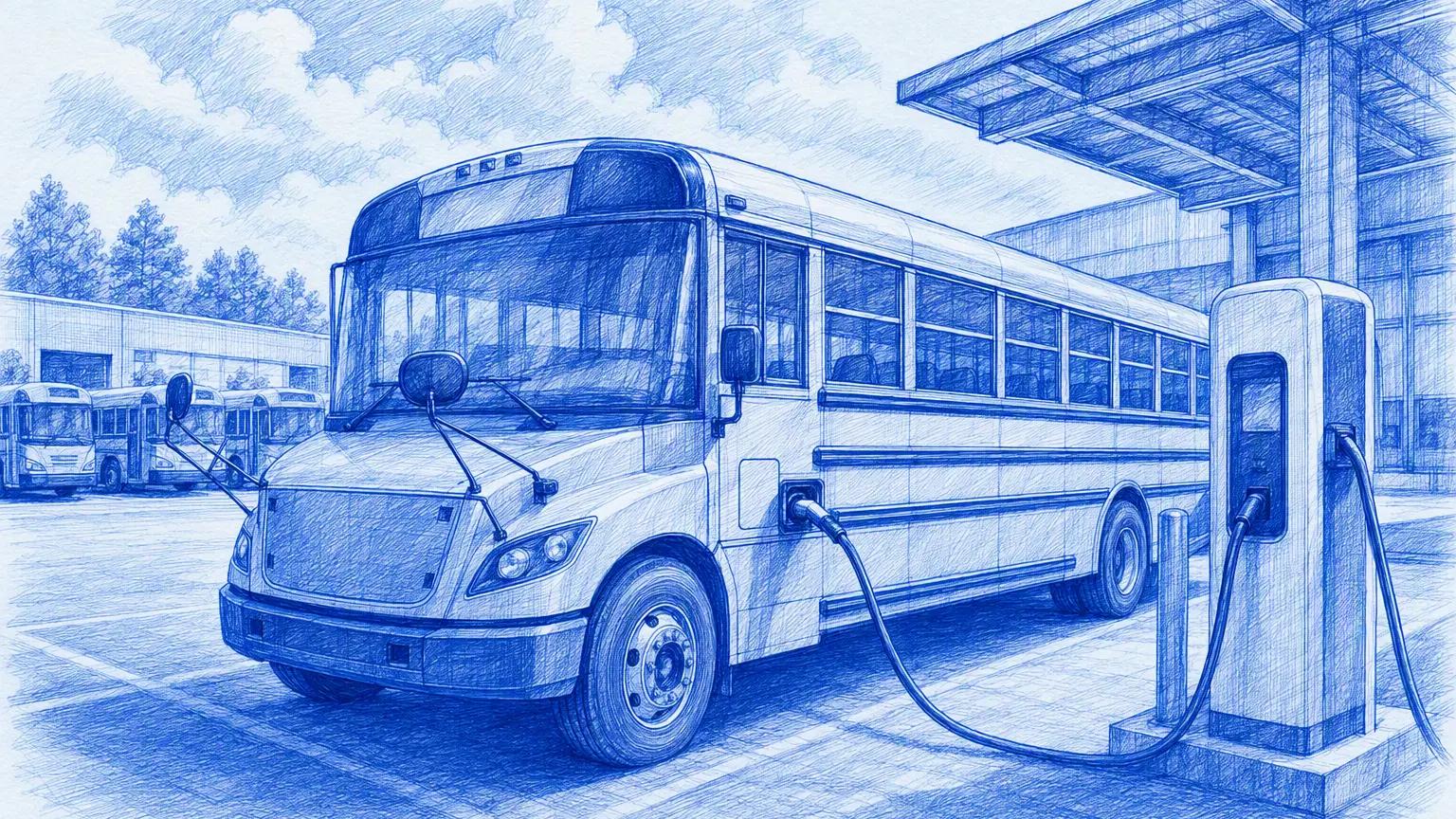
A school bus is close to a perfect grid battery. It sits still all day, it sits still all summer, and it carries a battery bigger than a house needs. Utilities have noticed.
World Resources Institute tracked the growth. Two years ago there were 15 utilities across 14 states running vehicle-to-grid programs for school buses. As of May 2025 there were 26 utilities across 19 states.
| Program location | Utility or program | What the district earns |
|---|---|---|
| Beverly, MA | National Grid ConnectedSolutions | About $6,000 per bus per year, at $200 per kW during peak events |
| South Burlington, VT | Green Mountain Power | About $9,000 per bus per year |
| White Plains, NY | ConEd distributed energy program | About $9,000 per bus per year |
| El Cajon, CA (Cajon Valley Union) | California Emergency Load Reduction Program | $2 per kWh delivered |
| Oakland, CA | Zum fleet, 70 plus buses | More than 2 MW returned during grid events |
| West Linn School District 3J, OR | Portland General Electric | Steady output across three hour events |
Source: World Resources Institute, May 2025 review of school bus vehicle-to-grid programs.
At $9,000 a year, a bus returns roughly $90,000 across a ten year life. That does not close a $300,000 price gap. It does change the arithmetic on the operating side, and for a district weighing a fleet it is real money.
The part the pilots keep running into
The same research names the barriers plainly, and they are not small.
- Battery warranty. Cycling a battery for the grid can conflict with the manufacturer warranty. This is the most common blocker.
- Interoperability. Bus, charger and utility software have to agree. Often they do not.
- Charger cost. Two way chargers cost more than ordinary ones, and the extra cost lands on the district.
- Compensation uncertainty. A district cannot budget against a rate that may change. Wells-Ogunquit in Maine put its pilot on hold over exactly this.
Districts are also reading past the averages. One analysis of an NV Energy structure found a fleet could earn about $6,700 a month and still lose roughly $6,300 a month once operations were counted. The program design decides whether this works, not the technology.
Where the investment actually went
The manufacturing side of this market split in two. One company scaled. One collapsed.
Blue Bird scaled
Blue Bird reported in its third quarter fiscal 2026 results that it delivered 355 electric buses in one quarter, out of 3,525 buses total. Electric is now about one in ten units it ships. Backlog holds more than 770 electric buses. Quarterly revenue was $517.2 million. Net income was $185.3 million.
The capacity came first. Blue Bird opened an EV Build-Up Center in Fort Valley, Georgia. It turned a 40,000 square foot building into an electric assembly line. Output rose from 4 vehicles a day toward 20. Stated long term capacity is 5,000 electric school buses a year.
The company is also reaching back into the chassis. Blue Bird agreed with Ford to build the next generation F53 and F59 stripped chassis. It is buying the assets of Detroit Chassis. Production starts in early 2028. That is a supplier taking control of its own supply chain.
Lion Electric collapsed
Lion Electric was valued near $5 billion at its peak. It entered creditor protection on December 18, 2024, with debts above $411 million. In May 2025 its remains were sold for roughly $6 million, and the Joliet plant closed permanently.
The consequence for districts was immediate. On July 15, 2025 the court appointed monitor told customers that warranties and orders outside Quebec were void. Close to 2,000 Lion buses already in service lost warranty coverage at once. Lion had earlier won a $159 million Clean School Bus award for 435 buses.
That is the key lesson in this market. An electric school bus is a 12 to 15 year asset bought from a young industry. Warranty and parts risk is procurement risk. It belongs in the scoring criteria, not a footnote.
Where the mandates actually stand
This is the part most coverage gets wrong, so it is worth stating carefully.
New York passed the strictest zero emission school bus law in the country. Most coverage still says it requires zero emission purchases by 2027. Those dates are no longer the law.
The 2026-27 enacted state budget moved both deadlines back five years. Education Law section 3638 now sets two dates. Districts must only buy or lease zero emission school buses by July 1, 2032. Every district must only operate them by July 1, 2040. Districts may also apply for up to two extensions of 24 months each.
| Requirement | Original deadline | Current deadline |
|---|---|---|
| Purchase or lease zero emission buses only | July 1, 2027 | July 1, 2032 |
| Operate a fully zero emission fleet | July 1, 2035 | July 1, 2040 |
| Extensions available | None stated | Up to two, 24 months each |
Source: New York Education Law section 3638, as amended by the 2026-27 enacted state budget.
Pressure is still on the law. Senate Bill S3328 would let a district file a one time opt-out waiver for a permanent exemption. It sits in the Senate Education Committee.
The gap between mandate and reality was the reason. As of September 2025, 68 of roughly 10,500 school buses in New York City were electric.
The lesson is not that mandates are fake. Compliance dates move when the money and the buses do not arrive. A plan pinned to one statutory date is fragile.
What districts are doing in the meantime
The records show three distinct strategies.
- Commit early and lock the utility in. Bakersfield City School District committed to 32 electric buses by the end of 2029 alongside a utility electrification agreement and a $17,000,000 program.
- Study the risk before buying. Oswego City School District funded a $15,000 project to analyze compliance risk under the zero emission mandate, covering route composition, bus types, battery capacity and charging infrastructure. That is a cheap way to avoid an expensive mistake.
- Stage it behind grant applications. Preston School District built a fleet transition plan around applying in 2026 and 2027 for roughly $940,000 in EPA Clean School Bus money and about $500,000 from the state environmental agency, to fund up to seven electric buses and chargers.
And some districts took a different road entirely. Mesa Unified District expanded a propane fleet instead, using a $750,000 clean school bus award, and reports earning about $250,000 a year in alternative fuel rebates for a running total of $924,254. Propane is not zero emission. It is available now, it is cheap, and it pays something back.
Culpeper County Public Schools shows the blended approach, budgeting five conventional buses alongside a separate grant funded electric bus and charging station package of about $872,000.
What comes next
For transportation directors
- Price the charger and the site work in the same board item as the bus. The infrastructure is a third of the program cost at Bakersfield scale.
- Put manufacturer solvency into the evaluation. Ask about parts availability, warranty backing and what happens if the builder fails. Two thousand districts learned this the hard way.
- Check whether your utility runs a vehicle-to-grid program before you spec chargers. Two way hardware has to be chosen up front.
- Confirm the compliance date that actually applies to you. In New York it is 2032, not 2027.
For vendors
- The charging and infrastructure spend is a separate, growing line. Downey Unified bought chargers on their own agenda item, not bundled with buses.
- Grant timing drives purchase timing. Award announcements, air district incentive programs and state clean bus rounds are the real pipeline signal.
- Fleet transition plans are published before the money moves. Preston laid out a two year application strategy in a public document.
- Propane and gas are not dead. They win on availability and price while electric waits on funding.
Open RFPs related to this topic
Live opportunities surfaced by Civic IQ as of October 2026. Status changes daily.
- NYSERDA School Bus Incentive Program, NY (due 2030-12-30)
- Bus Garage EV Charging Project ITB, Bell County Schools, KY (due 2026-10-08)
- Bus Electrification Project Bid, San Lorenzo Valley USD, CA
- Blue Sky Grant Program RFP 2026, Feather River AQMD, CA (due 2026-10-16)
Frequently asked questions
How much does an electric school bus cost?
Between $300,000 and $440,000 by size. That is about three times a diesel bus. Hazel Park in Michigan paid $394,308 per bus. Districts in California and Montana paid about $432,500. With chargers and site work, Bakersfield budgeted near $531,000 per bus.
How far can an electric school bus go on one charge?
Blue Bird rates its Vision and All American electric buses at up to 120 miles. That covers most daily routes. Long rural routes need planning around charging windows.
Can school buses send power back to the grid?
Yes, through vehicle-to-grid programs. As of May 2025, 26 utilities across 19 states ran them. Two years earlier it was 15 utilities. Districts in Vermont and New York earn about $9,000 per bus per year. In Massachusetts it is about $6,000.
Is New York still requiring electric school buses by 2027?
No. The 2026-27 enacted state budget moved the deadline. Districts must buy only zero emission buses by July 1, 2032. They must run a fully zero emission fleet by July 1, 2040. Districts can also apply for up to two extensions of 24 months each.
What happened to Lion Electric?
It entered creditor protection in December 2024 with debts above $411 million. Its assets sold for roughly $6 million in May 2025. On July 15, 2025 the monitor told customers that warranties and orders outside Quebec were void. Close to 2,000 buses lost warranty coverage.
Are electric school buses worth it for a district?
It depends on the funding and the utility. Nearly every order in the records carries grant money. Grid payback of $6,000 to $9,000 a year helps the operating side. It does not close the purchase price gap. Districts without either usually buy propane or diesel.
Related reading: our analysis of what districts actually pay for school buses, our look at school transportation software pricing and vendors, and our guide to municipal EV charging infrastructure opportunities.
Purchase figures come from individual records surfaced by Civic IQ from board agendas, purchase orders and checkbook data. Grid program figures come from World Resources Institute research. Manufacturer figures come from company filings and announcements. Statutory dates come from the cited New York statute. Civic IQ tracks 100,000+ agencies, $14T+ in tracked spend, 1.5M+ documents per month, all 50 states.