Cloverleaf AI vs Civic IQ: Meeting Intelligence vs Signal-to-Pipeline
The short answer
Both platforms read public government meetings, so this comparison is not about who sees the meeting first. Cloverleaf AI is meeting intelligence: 70,000+ agencies monitored, Vocal Fingerprinting across 200,000+ verified speakers, and a pre-RFP Opportunity Database. Civic IQ covers the same meetings across 100,000+ agencies and then adds what happens next: purchase order and spend records, an agency contact database, outreach sequencing from the rep's own mailbox, and active RFP search. Choose Cloverleaf if monitoring is your only gap. Choose Civic IQ if you need to act on the signal and close it.
This page is the head-to-head. Comparing more than these two? See all 4 Cloverleaf AI alternatives.
Quick verdict
These two are closer than any other pair in the category: both read public government meetings to surface intent before an RFP publishes, and both do it well. The difference is scope. Cloverleaf AI is meeting intelligence, sharpened by Vocal Fingerprinting across 200,000+ verified speakers. Civic IQ treats the meeting signal as the first step and carries it through spend records, contacts, sequencing, and active RFP search.
Best for
Choose Cloverleaf AI if reading every board meeting in your territory is your only gap, you want a daily digest, and following named officials is the specific capability you're after. Choose Civic IQ if you need the signal plus the spend record, the contact, the sequence, and the active solicitation in one place.
Our take
Ask what happens after the signal arrives. If your reps already have contacts, spend history, and a sending tool, meeting intelligence may be the only piece you're missing and Cloverleaf covers it. If the signal currently lands in an inbox and stalls there, the gap isn't monitoring.
Why teams compare Civic IQ and Cloverleaf AI
Most comparisons in this category are between platforms betting on different things: federal analyst coverage, historical spend, proposal writing, breadth. Civic IQ and Cloverleaf AI are the exception. Both read public government meetings, both transcribe them at scale, and both promise the same thing — that you'll hear about the project while it's still being discussed rather than when the RFP drops. That shared premise is why they land in the same evaluations.
So the useful comparison isn't who gets there earlier. It's what the platform does once the signal exists. Cloverleaf sharpens the monitoring itself, most distinctively with Vocal Fingerprinting, which follows a named official across every meeting they attend. Civic IQ treats the signal as the beginning of a pipeline and carries it forward into purchase records, contacts, outreach, and the active solicitation. Every row below reflects what each company describes publicly as of October 2026.
Company profile
About Cloverleaf AI
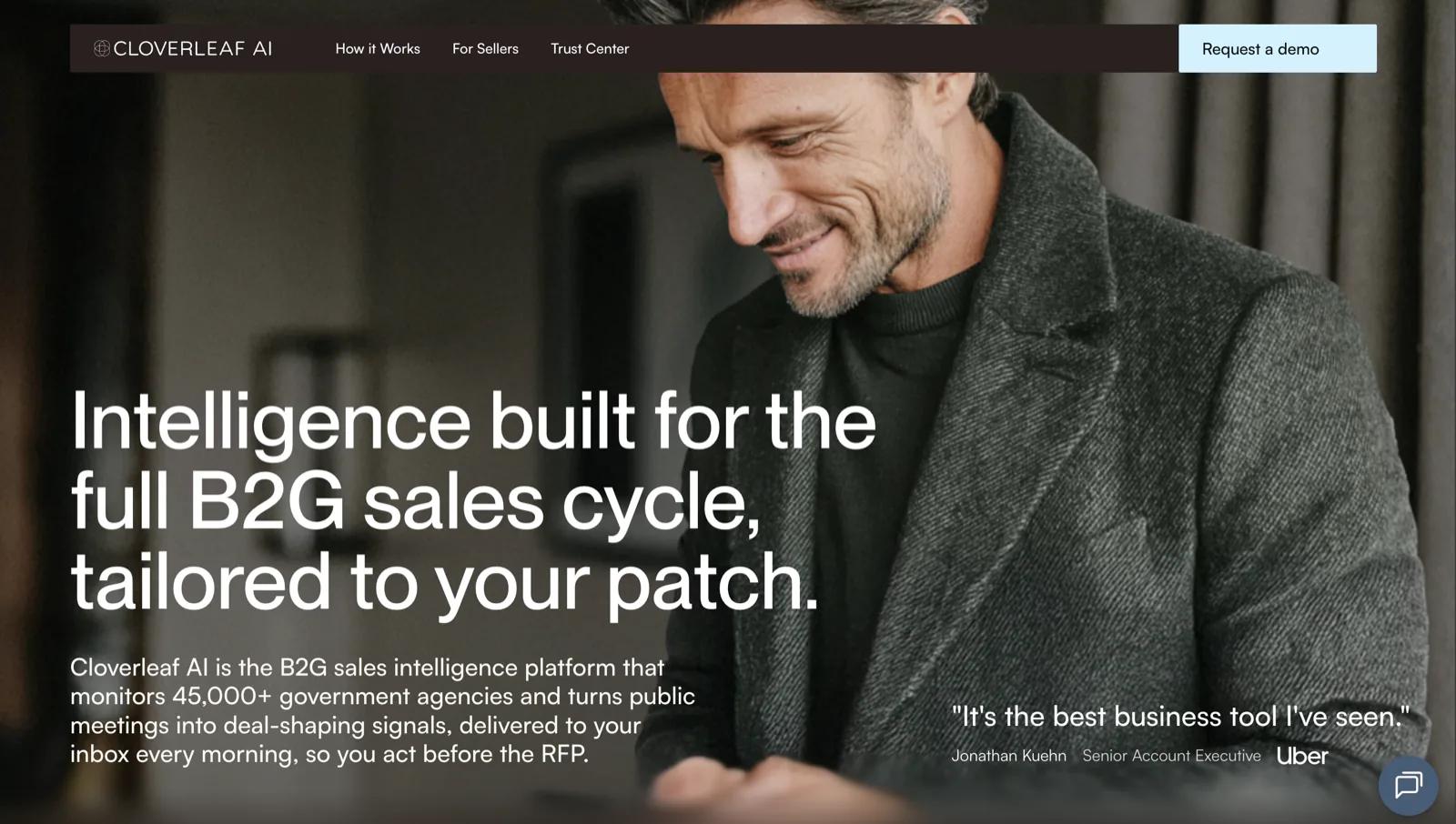
Cloverleaf AI is a Denver-based B2G sales intelligence platform founded in 2021, built around a single job: reading public government meetings so vendors don't have to. It transcribes meeting video and captures the surrounding documents — agendas, minutes, budget plans, capital improvement programs — across 70,000+ agencies by its own account, and delivers the resulting signals as a daily digest.
Its most distinctive capability is Vocal Fingerprinting. A custom speech-to-text API builds a voice signature for each speaker, with more than 200,000 verified public-sector speakers in the database, so a vendor can follow one named official across every public meeting they attend and watch their position evolve over time. Per its 2024 funding announcement, Cloverleaf also indexes more than 100,000 monthly opportunities before they reach the RFP stage, and it delivers into the CRM through a Salesforce AppExchange listing.
It raised a $2.8M seed round in November 2024 led by Jackson Square Ventures, and in August 2025 announced an exclusive partnership with e.Republic to power AI-driven signals inside Industry Navigator. Its August 2026 Series A announcement says MCP and native CRM integrations now put that intelligence where sellers already work. The product is focused rather than broad: its public materials describe meeting intelligence, and do not describe purchase order data, a queryable contact database, an outreach sending engine, or active solicitation search.
Pricing
Not published. Quoted per customer, scoped to the buyer's needs
Civic IQ approach
The signal is the first step, not the product
The same public meetings, across 100,000+ agencies, then the spend record behind the signal, the contact to email, a sequence that sends from the rep's own mailbox, the active RFP when it posts, and an MCP server so your own agents can query all of it.
Cloverleaf AI approach
Read every meeting, sharpen the reading
Meeting intelligence as the whole product across 70,000+ agencies, delivered as a daily digest, with Vocal Fingerprinting following named officials across 200,000+ verified speakers and a pre-RFP Opportunity Database.
Feature-by-feature comparison
Each row reflects what each company describes publicly as of October 2026. Where Cloverleaf's materials don't describe a capability, the row says so rather than asserting it doesn't exist. You can also query this from Claude or ChatGPT with the public meetings MCP.
| Capability | Civic IQ | Cloverleaf AI |
|---|---|---|
| Core bet | Signal to closed pipeline | Meeting intelligence |
| Public meeting monitoring | Yes, core product | Yes, core product |
| Agencies monitored | 100,000+ (self-reported) | 70,000+ (self-reported) |
| Pre-RFP signal timing | 6-18 months before the RFP | At the discussion stage |
| Speaker tracking | Not offered | Vocal Fingerprinting, 200,000+ verified speakers |
| Purchase order / spend records | Yes, by agency with amounts and dates | Not described |
| Agency contact database | Yes, 2.6M+ contacts by agency, title, state | Speaker ID from meetings; no contact database described |
| Outreach sequencing | Yes, sends from the rep's own mailbox | AI-drafted copy described; no sending engine described |
| Managed SDR service | Yes (Pipeline-as-a-Service) | Not advertised |
| Active RFP / bid search | Yes, active and past by keyword, agency, state, status | Pre-RFP Opportunity Database; no active-solicitation search described |
| MCP server for AI agents | Yes, live for Claude, ChatGPT, and any MCP client | Yes (announced August 2026) |
| CRM integration | Salesforce, HubSpot, Apollo, Instantly, ZeroBounce | Salesforce (AppExchange listing) |
| Chrome extension | Yes, free: verified contacts and AI agency summaries in-page | Not advertised |
| Pricing | Free; Starter $299/mo; Unlimited quoted | Quoted per customer, not published |
The distinction that matters most
Cloverleaf's Opportunity Database captures opportunities before they reach the RFP stage, by its own description. That is pre-RFP signal, and it is valuable. Searching the active solicitation you have to answer this month is a separate job. A team doing both needs both.
What Cloverleaf AI does well
Meeting monitoring, and it is good at it. An honest comparison starts there.
Meeting monitoring, and it is good at it
This is the honest starting point. Cloverleaf monitors 70,000+ government agencies by its own account, transcribing public meeting video and documents and delivering signals to your inbox each morning. If your only gap is that you cannot read every board meeting in your territory, that gap is covered.
Vocal Fingerprinting on named officials
Cloverleaf's custom speech-to-text builds a voice signature per speaker, with more than 200,000 verified public-sector speakers in its database. That lets you follow one named official across every public meeting they attend, across agencies and jurisdictions, and see how their position has evolved. Civic IQ does not offer an equivalent, and it is a genuinely distinctive capability.
A pre-RFP Opportunity Database at scale
Per its 2024 funding announcement, Cloverleaf indexes more than 100,000 monthly government opportunities before they reach the RFP stage, alongside speaker identification, sentiment analysis, and meeting summaries. That is substantial pre-RFP coverage.
Salesforce delivery and a focused product
Cloverleaf pushes intelligence into the CRM through a Salesforce AppExchange listing, and the product does one job rather than many. A team that wants meeting intelligence and nothing else will find less to configure and less to ignore.
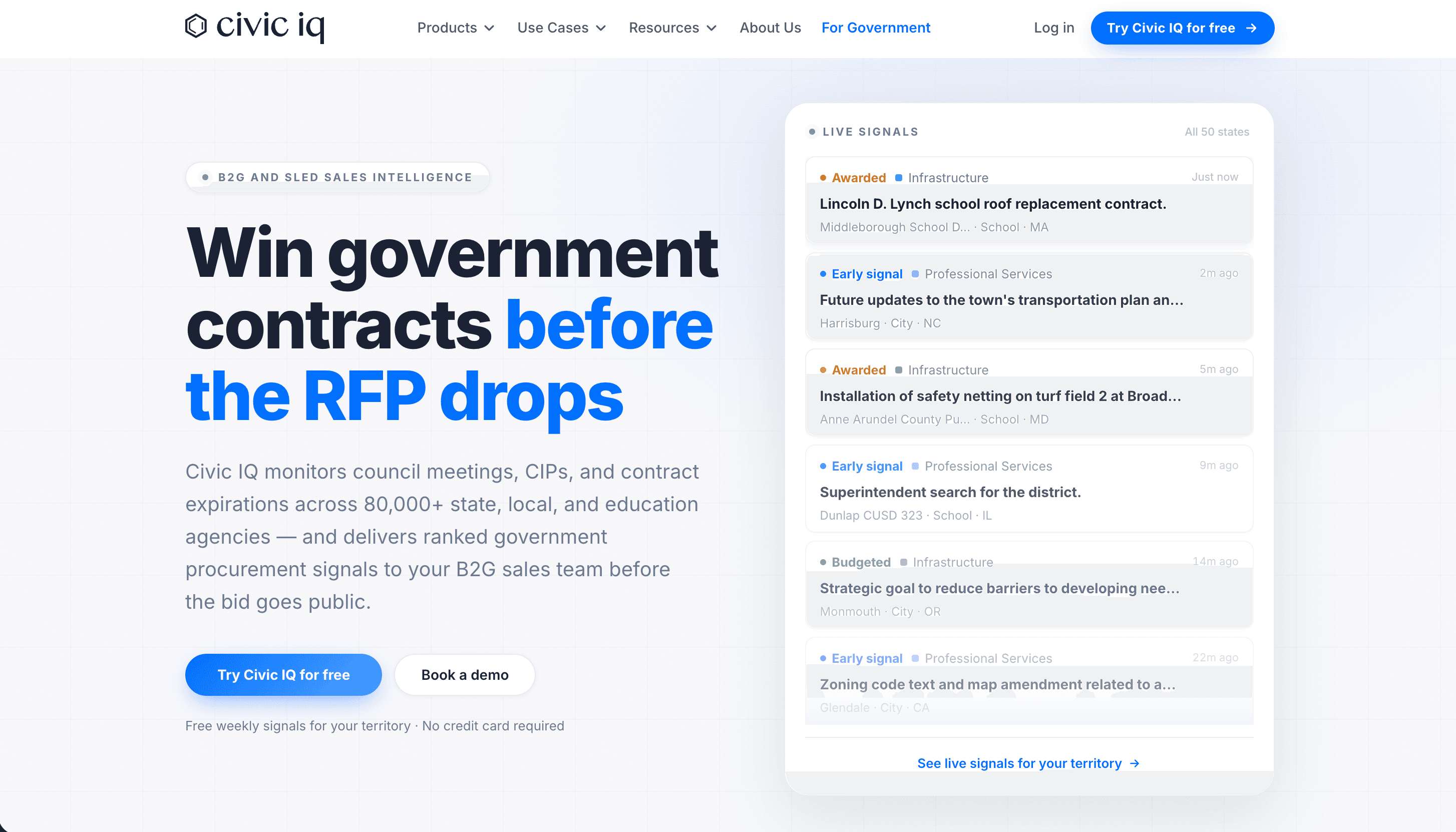
Where Civic IQ goes further
Five places, and all five are about what happens after the signal arrives.
Purchase order and spend records behind the signal
A meeting tells you there's interest. A purchase order tells you there's budget. Civic IQ pairs the meeting signal with vendor spend and purchase records by agency, including amounts, dates, the incumbent, and the contract term end. Cloverleaf's public materials don't describe purchase order or spend datasets.
A contact database you can build a list from
Speaker identification answers who talked in the room. A contact database answers who to email, at what title, across your whole territory. Civic IQ carries queryable agency staff contacts by agency, title, and state; Cloverleaf describes speaker identification from meetings rather than a contact database.
Outreach that actually sends
Civic IQ launches a multi-step email sequence from the rep's own mailbox, so the signal becomes a conversation without an export step. Cloverleaf does market AI-generated outreach copy, which is real, but its materials don't describe a sending or sequencing engine.
Active RFP search alongside the pre-RFP signal
Both platforms are strong before the RFP. The gap opens later: a tracked deal finally posts as a bid and you need the document, the deadline, and the contact in one place. Civic IQ searches active and past solicitations by keyword, agency, state, and status.
Agent access to the whole dataset
Both platforms now offer MCP access; Cloverleaf announced it with its August 2026 Series A. Civic IQ's Model Context Protocol server has nine tools covering signals, vendors, contracts, RFPs, and contacts, so your own AI agent can query the spend records, contacts, and solicitations described above along with the meeting signal.
Managed SDR service (Pipeline as a Service)
Civic IQ can work the pipeline for you. Pipeline as a Service puts a dedicated SDR on your account, onboarded on your ICP and product, making 40–50 signal-triggered calls a day and booking 4–8 qualified government meetings a month straight to your calendar. Every outreach is triggered by a live procurement signal rather than a cold list, and a weekly report covers calls, emails, open rates, replies, and meetings booked. It starts at $2,000/month on top of an active platform subscription and takes about a week to launch.
Why purchase order and spend data matters
A meeting tells you interest. A purchase order tells you budget. One is a hypothesis; the other proves the agency already spends in your category. Real records show the range, and each figure is a floor, because this view keeps one purchase per vendor.
Spend records also name the incumbent and the term end date. That is what turns a cold call into a conversation.
How do the two compare on coverage?
Civic IQ reports 100,000+ agencies across all 50 states. Cloverleaf AI reports 70,000+ government agencies. Both figures are self-reported and the two may not count the same way.
Ask both vendors the same question before you compare the numbers: what counts as a covered agency, and how many of them published a document in the last 90 days? A directory entry that never posts anything is not coverage.
Use cases
Which platform fits your scenario?
Real-world scenarios and which platform serves each one best.
Your only gap is that nobody can read every board meeting
CLOVERLEAFYour reps have contacts, they know their accounts, and they have a sequencing tool. What they don't have is any way to know what was discussed in 400 board meetings last month. That is precisely the job Cloverleaf does, and a daily digest may be all you need.
You want to follow specific named officials across jurisdictions
CLOVERLEAFYou sell to a small set of decision-makers who move between roles and appear in multiple bodies — city council, county commission, state hearings. Cloverleaf's Vocal Fingerprinting is built for exactly this and Civic IQ has no equivalent. It's the clearest reason to pick Cloverleaf.
The signal arrives and then stalls
CIVIC IQYou already get meeting alerts and they sit in an inbox, because acting on one means finding the right contact, checking whether the agency has budget history in your category, and building a sequence somewhere else. Civic IQ closes that loop in one system: spend record, contact, sequence, and the RFP when it posts.
You want your own AI agent to query more than meetings
CIVIC IQYou're building internal agents and want the government data as a source your systems read, not a dashboard a person visits. Both platforms now offer MCP access; Cloverleaf announced it in August 2026. Civic IQ's MCP server has nine tools covering signals, vendor spend, contracts, RFPs, and contacts, so the agent can also reach the spend record and the contact behind a meeting signal.
You want redundant meeting coverage across two agency sets
BOTHThe two report different agency totals and almost certainly count differently, so running both genuinely widens coverage. It also means paying twice for the same core job, so it only makes sense with budget to spare and a territory where missing a meeting is expensive.
What to ask in a demo
Six questions that surface real differences between these two. Feature lists will not.
- 1Show me a signal from a meeting document, with the agency, date, and dollar amount on screen.
- 2For that same agency, show me what they already bought in my category and when the contract ends.
- 3Show me the contacts at that agency, by title.
- 4Can I launch an outreach sequence from here, or do I export to another tool?
- 5Can my own AI agent query this data directly, and over what protocol?
- 6When that deal posts as an active RFP, do I see the solicitation here?
A platform that answers question one well and stalls on two through six is a monitoring tool. A pipeline tool answers all six. That is the whole comparison.
Choose Civic IQ when...
- Your meeting alerts arrive and then stall for want of a contact or a sequence
- You need to know whether the agency already spends in your category, and with whom
- You want the active solicitation and the pre-RFP signal in one place
- You want your own AI agents to query spend, contacts, and RFPs over MCP alongside the meeting signal
- You'd rather run outreach from the rep's own mailbox than export a list
Choose Cloverleaf AI when...
- Meeting monitoring is genuinely your only gap
- Following named officials across jurisdictions is the capability you want
- You prefer a daily digest to a platform you work inside
- Your CRM is Salesforce and a single AppExchange delivery path is enough
- You already own spend data, contacts, and a sequencing tool elsewhere
Can you use Civic IQ and Cloverleaf AI together?
You can, and it is a reasonable choice if you have the budget and want redundant meeting coverage across two different agency sets — the two report different totals and almost certainly count differently, so the overlap is not complete. But meeting monitoring is the core of both products, so you would be paying twice for the same job. Most teams decide instead on scope: whether they need the signal alone, or the signal plus the spend record, the contact, the sequence, and the active solicitation.
The bottom line
Cloverleaf AI reads public government meetings well, and Vocal Fingerprinting on named officials is a real capability Civic IQ does not match. If reading every board meeting in your territory is the gap you have, it is a legitimate choice.
But a signal is only worth what you can do with it. If yours currently lands in an inbox and stalls there for want of a spend record, a contact, a sequence, or the solicitation itself, the gap is not monitoring.
Get started freeFrequently asked questions
Yes, for teams that need to act on a signal rather than only receive it. Both platforms read public government meetings. Civic IQ then adds purchase order and spend records, an agency contact database, outreach sequencing, and active RFP search. If meeting monitoring alone is your gap, Cloverleaf covers it well.
Its public materials do not describe purchase order or spend datasets. Cloverleaf AI is positioned around meeting intelligence: 70,000+ agencies monitored, speaker identification, sentiment analysis, and an Opportunity Database of pre-RFP opportunities. Civic IQ carries vendor spend and purchase records by agency, with amounts, dates, and contract terms.
Yes. Cloverleaf AI's August 2026 Series A announcement says its intelligence now reaches sellers through MCP and native CRM integrations. Civic IQ also ships a Model Context Protocol server with nine tools, so an AI agent can query signals, vendor spend, contracts, RFPs, and contacts directly instead of a person working inside a dashboard.
It markets an Opportunity Database that captures opportunities before they reach the RFP stage, by its own description. That is pre-RFP signal, and it is valuable. Searching the active published solicitation you have to answer this month is a separate job. Civic IQ covers both active and past RFPs by keyword, agency, state, and status.
Cloverleaf AI does not publish pricing and quotes per customer. Civic IQ publishes its pricing: a free plan, Starter at $299/month, and Unlimited quoted by territory and seat count. Ask both for the total on the seats you actually need, plus the year-two price.
Civic IQ reports 100,000+ agencies and Cloverleaf AI reports 70,000+, but both numbers are self-reported and may count differently. The more useful question for either vendor is how many covered agencies published a document in the last 90 days, and whether your specific states and categories are among them.
You can, and some teams will if they want redundant meeting coverage across two different agency sets. There is real overlap, though, since meeting monitoring is the core of both. More often the choice is whether you need only the signal, or the signal plus the spend record, the contact, the sequence, and the active RFP.
Comparing more than these two? See all 4 Cloverleaf AI alternatives.