Civic IQ vs GovSpend: Pre-RFP Signals vs Spend Data
The short answer
GovSpend tells you what agencies bought last year; Civic IQ tells you what they're planning to buy next year. GovSpend owns the deepest historical spend archive in government, $12T+ in documented spend, and is unmatched for benchmarking and research. Civic IQ reads 1.5M+ documents monthly to surface pre-RFP signals, with 2.6M+ contacts and outreach built in. Pick by whether you research backward or sell forward. Many teams run both.
This page is the head-to-head. Comparing more than these two? See the 7 best GovSpend alternatives and competitors.
Quick verdict
GovSpend and Civic IQ answer fundamentally different questions. GovSpend tells you what agencies bought last year with unmatched PO-level spending data. Civic IQ tells you what they're planning to buy next year by reading 1.5M+ government documents monthly. GovSpend has been adding AI features aggressively, but its foundation is historical data; Civic IQ's foundation is forward-looking intelligence.
Best for
Choose GovSpend for market research, spending analysis, and vendor benchmarking. Choose Civic IQ for pre-RFP signal detection, contacts linked to buying intent, and built-in sales execution.
Our take
If your workflow is research-first (understanding market size, pricing, competition), GovSpend is the better tool. If your workflow is sales-first (finding buyers early and reaching out), Civic IQ is purpose-built for that. Many data-driven teams use both.
Why teams compare GovSpend and Civic IQ
GovSpend and Civic IQ are increasingly mentioned together as SLED intelligence platforms, but they approach the market from opposite directions. GovSpend, founded in 2011 and now backed by Thompson Street Capital Partners, was built on the largest database of government purchase orders and spending records in the industry, documenting $12T+ in spend. Civic IQ was built on AI-powered document analysis, a forward-looking foundation that tells you what's about to happen, not what already happened.
In the last two years, the lines have started to blur. GovSpend has invested heavily in AI, adding Meeting Intelligence, AI Search, AI Chat, AI Notebook, and an Opportunities module, all well-integrated across five platform modules. They've also acquired Fedmine to bring 19 federal datasets into the platform, giving teams combined SLED and federal spending intelligence. These aren't marketing features; they represent genuine product investment under CEO Nate Haskins.
This comparison is for teams trying to decide between the two, or wondering whether they need both. We'll break down where each platform genuinely excels, where the overlap is growing, and which use cases each one is better suited for in 2026.
Company profile
About GovSpend
GovSpend was founded in 2011 by Jack Siney and Jeffrey Rubenstein. The origin story is distinctive: Rubenstein created the initial government spending database while serving as an auxiliary police officer, motivated by a desire to bring transparency to public sector spending. What started as a transparency tool evolved into the deepest government purchase order database in the industry, now documenting $12T+ in spend across 2B+ purchase orders.
In 2020, Thompson Street Capital Partners made a majority investment in GovSpend, and in 2021 GovSpend acquired Fedmine (founded 2004), which brought 19 federal datasets into the platform. This gave GovSpend the ability to offer combined SLED and federal spending intelligence under one roof. The company is headquartered in Boca Raton, Florida and led by CEO Nate Haskins.
GovSpend has been one of the most aggressive platforms in adding AI capabilities. Their 2025-2026 AI suite includes AI Bid Summaries, Contracts+AI, Meetings+AI, Spending+AI, AI Notebook, and AI Search, all fully integrated across the platform rather than bolt-on features. They're also bringing AI Search to Slack and Microsoft Copilot, and investing in AI Data Operations to automate data sourcing, enrichment, and ingestion. These are real, well-integrated features, but they sit on top of a foundation built around historical spending data, not forward-looking document intelligence.
Pricing
Module-based pricing (Spending, Meetings, Bids, Opportunities, Contacts). Tiered plans with custom enterprise pricing. Not publicly listed
Civic IQ approach
What agencies are about to buy
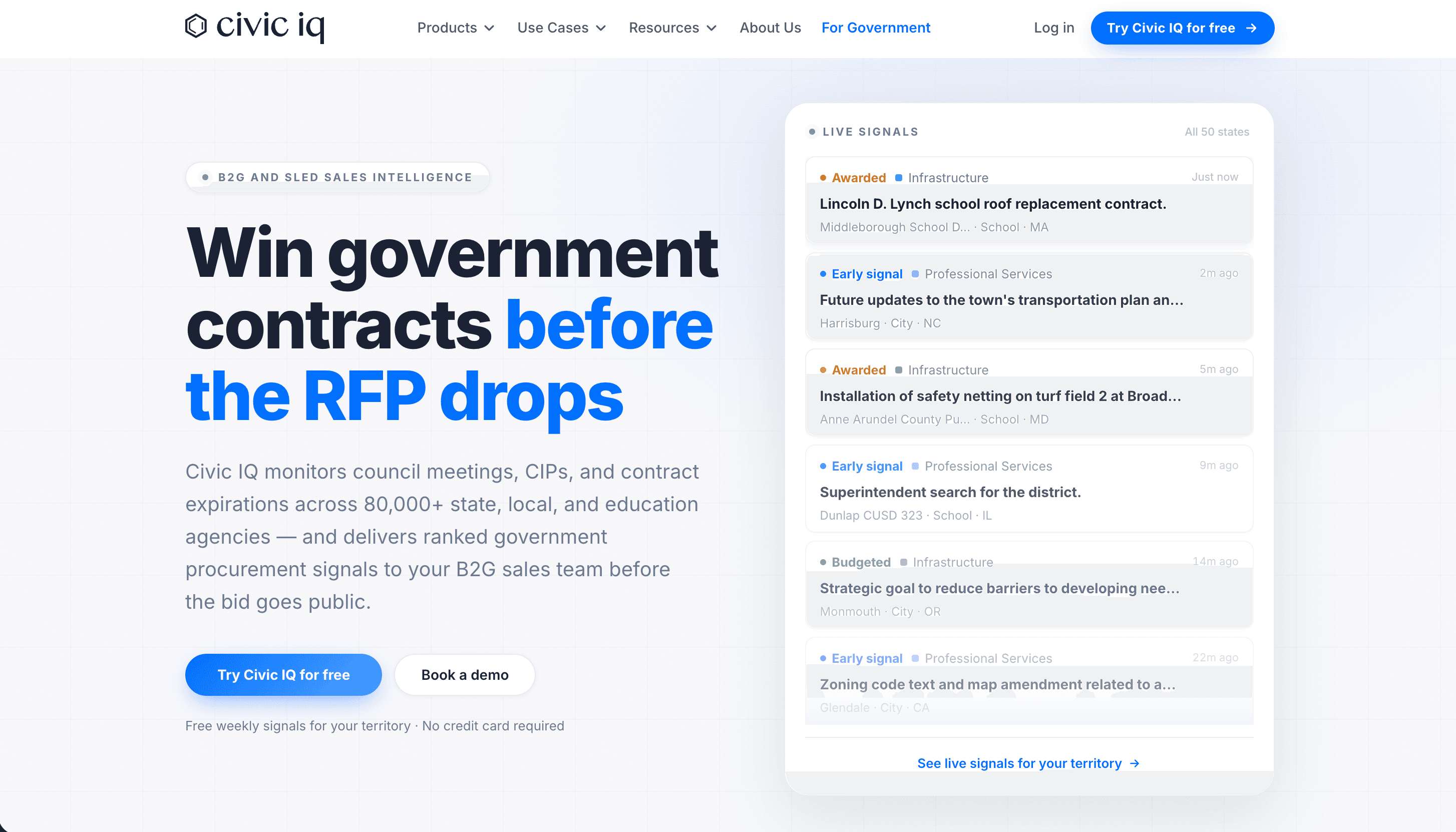
AI reads 1.5M+ government documents monthly across 100,000+ SLED agencies to surface pre-RFP buying signals, then gives you contacts, email sequences, and pipeline management to act on them.
GovSpend approach
What agencies already bought
A $12T+ archive of documented spend from line-item purchase orders and spending records, plus a five-module AI suite (Meetings+AI, Spending+AI, and more) for benchmarking, market sizing, and vendor pricing research.
Feature-by-feature comparison
Here's how Civic IQ and GovSpend stack up across the features that matter most for government sales teams. For a broader comparison that includes GovWin IQ, GovTribe, and GovDash, see our full platform comparison. You can also query this from Claude or ChatGPT with the government spending MCP.
| Feature | Civic IQ | GovSpend |
|---|---|---|
| Primary data source | Government documents (meetings, budgets, agendas) | Purchase orders and spending records |
| Pre-RFP signal detection | Core focus | Yes (Opportunities module) |
| Meeting Intelligence | Built-in, 1.5M+ docs/month | Yes (AI-powered module) |
| Historical spending data | Yes | Core focus (line-item POs) |
| SLED agency coverage | 100,000+ agencies | Broad |
| Contact database | 2.6M+ contacts | PO and contract-linked |
| Federal coverage | Limited | Yes (via Fedmine) |
| Bids & RFPs | Yes | Yes |
| Co-ops & contracts | Partial | Yes |
| Competitor intelligence from meetings | Yes | Partial |
| Email sequences & outreach | Built-in | No |
| Sales pipeline management | Built-in | No |
| Managed SDR service | Yes (Pipeline-as-a-Service) | Not advertised |
| CRM integrations | Salesforce, HubSpot, Pipedrive, Zoho | Salesforce, HubSpot (full module sync), Microsoft Dynamics |
| AI chatbot & search | Yes | Yes (AI Search, AI Chat, AI Notebook) |
| Custom account lists | Yes, with collaboration | Partial |
| Vendor benchmarking | Partial | Yes (core strength) |
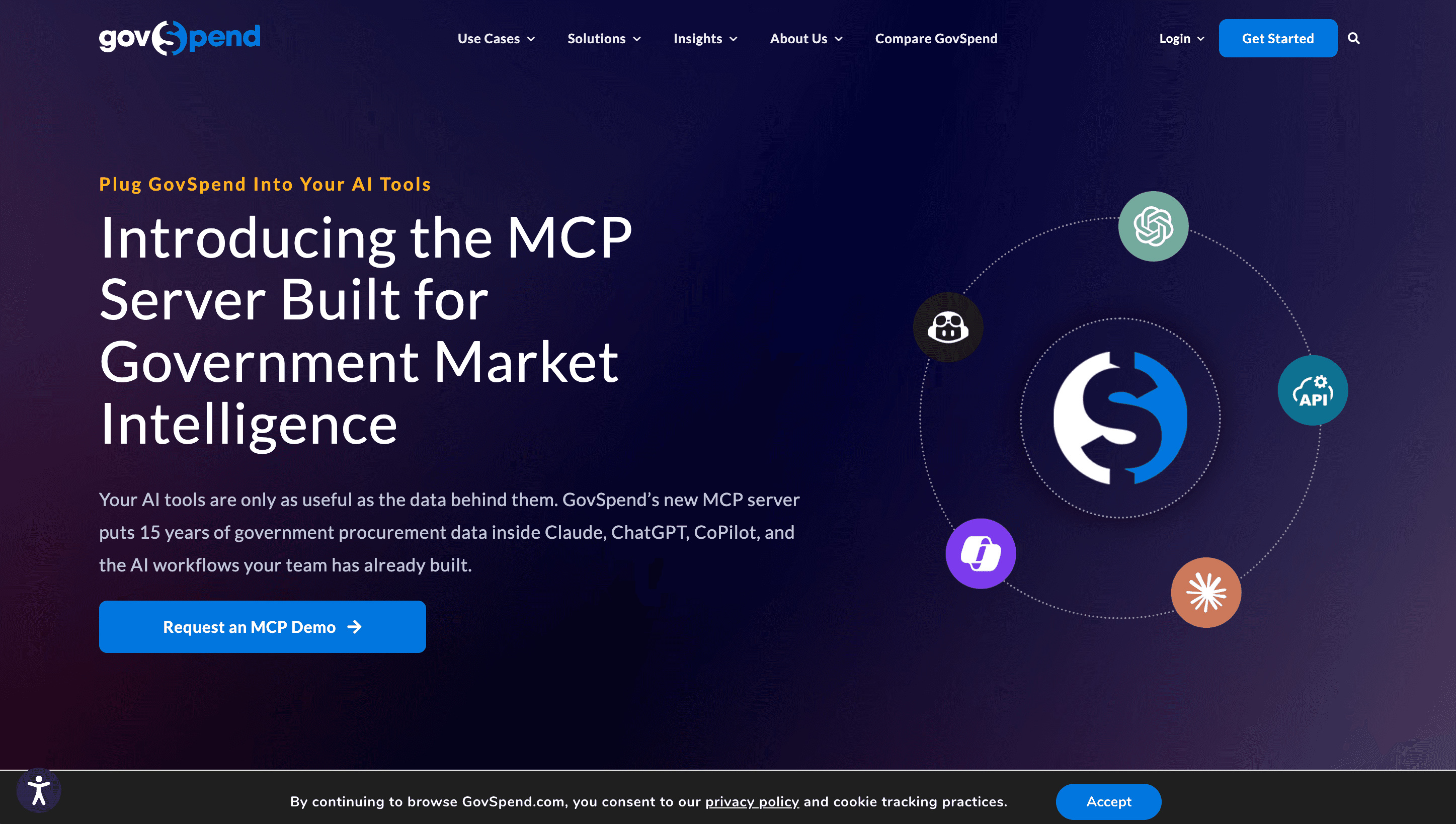
| MCP server for AI agents | Yes, live for Claude, ChatGPT, and any MCP client | Yes, launched June 2026 |
| Chrome extension | Yes, free: verified contacts and AI agency summaries in-page | Not advertised |
Where Civic IQ is stronger
Areas where Civic IQ has a meaningful advantage over GovSpend.
Forward-looking vs backward-looking
Civic IQ is built around what agencies are planning to buy. GovSpend is built around what they already bought. Both are valuable, but if your goal is to get in before the RFP, forward-looking intelligence gives you the head start.
Larger, signal-linked contact database
Civic IQ has 2.6M+ contacts sourced directly from official agency websites and public records, each linked to live buying signals. GovSpend's contacts are tied to historical POs and contract signatures, which may not reflect current roles or active procurement.
Built-in sales execution tools
Email sequences, pipeline management, and outreach campaigns are built into Civic IQ. GovSpend is an intelligence and research platform. To act on what you find, you need separate outreach tools.
Deeper competitor intelligence
Civic IQ surfaces what agencies are saying about your competitors in their meetings: dissatisfaction, vendor evaluations, contract concerns. GovSpend shows which vendors won contracts, but doesn't analyze meeting sentiment.
More CRM options
Civic IQ integrates with Salesforce, HubSpot, Pipedrive, and Zoho. GovSpend offers deep Salesforce and HubSpot integrations with full module sync, plus Microsoft Dynamics, but doesn't support Pipedrive or Zoho.
Managed SDR service (Pipeline as a Service)
Civic IQ can work the pipeline for you. Pipeline as a Service puts a dedicated SDR on your account, onboarded on your ICP and product, making 40–50 signal-triggered calls a day and booking 4–8 qualified government meetings a month straight to your calendar. Every outreach is triggered by a live procurement signal rather than a cold list, and a weekly report covers calls, emails, open rates, replies, and meetings booked. It starts at $2,000/month on top of an active platform subscription and takes about a week to launch.
Where GovSpend is stronger
We're biased, but here's where GovSpend genuinely has the edge.
Deep historical spending data
This is GovSpend's core strength and it's genuinely hard to match. Line-item purchase order data, contract awards, vendor pricing, and spending trends. If you need to know exactly what an agency spent on your category last year, GovSpend has it at a level of detail nobody else offers.
Vendor benchmarking and pricing intelligence
GovSpend lets you see what competitors are charging for similar products. This is valuable for pricing strategy and competitive positioning. Civic IQ doesn't offer this kind of pricing intelligence.
Federal coverage via Fedmine
GovSpend acquired Fedmine and offers 19 federal datasets. This gives teams a single vendor for SLED + federal spending data, even though the interfaces are separate. Civic IQ's federal coverage is limited.
Mature AI tools across all modules
GovSpend has been aggressive about adding AI: AI Search, AI Chat, AI Notebook, and AI prompts inside bids, meetings, and contracts. These are well-integrated across all five modules, not bolt-on features.
Co-ops and contract tracking
GovSpend tracks cooperative purchasing agreements and contract vehicles, helping teams understand which contracts are available for piggybacking. This is useful for agencies that buy off existing contracts rather than issuing new RFPs.
Use cases
Which platform fits your scenario?
Real-world scenarios and which platform serves each one best.
Sales team looking to fill pipeline with early-stage SLED opportunities
CIVIC IQYour reps need a daily flow of new leads from agencies that are in the early stages of considering a purchase. You want buying signals from budget hearings and planning meetings, contacts for the right decision-makers, and the ability to send outreach sequences without switching tools. Civic IQ's pre-RFP intelligence and built-in sales tools are designed for exactly this workflow. GovSpend's spending data is valuable context, but it doesn't drive the daily prospecting motion.
Market research team sizing a new government vertical
GOVSPENDYour company is considering entering a new SLED market (e.g., K-12 cybersecurity) and needs to understand: how much do districts spend in this category? Which vendors currently win this work? What price points are competitive? GovSpend's line-item PO data and vendor benchmarking are uniquely suited for this analysis. Civic IQ can tell you which districts are discussing new cybersecurity initiatives, but for the historical market sizing, GovSpend is the better tool.
Account-based sales team targeting specific agencies
BOTHYou've identified 50 high-priority SLED agencies. You want to know what they bought last year (GovSpend) AND what they're planning to buy next (Civic IQ). You want historical spending patterns for context and pre-RFP signals for timing. Teams running an account-based approach often get the most value from pairing both platforms: GovSpend for the historical picture, Civic IQ for the forward-looking signals and outreach.
Government sales rep who needs to prospect and close independently
CIVIC IQYou're a solo rep or part of a small sales team without dedicated research support. You need one platform that helps you find opportunities, identify the right contacts, and run outreach campaigns. Civic IQ combines intelligence, contacts, and sales tools in a single workflow. GovSpend is a powerful research platform, but acting on what you find requires separate outreach and CRM tools.
Choose Civic IQ when...
- You sell into SLED and win by getting in before the RFP
- You want 2.6M+ contacts linked to live buying signals
- You want email sequences and pipeline management built in
- You need Pipedrive or Zoho CRM (GovSpend supports neither)
- You want competitor intelligence from government meetings
Choose GovSpend when...
- Your job is spend research and vendor price benchmarking
- You need line-item purchase-order history at depth
- You need combined SLED + federal spend data (via Fedmine)
- You track co-ops and contract vehicles for piggyback buys
- Your bottleneck is analysis, not finding deals early
Can you use Civic IQ and GovSpend together?
Yes, and data-driven teams often do. GovSpend answers backward-looking questions (what did this agency pay, who supplies them now) while Civic IQ answers forward-looking ones (what are they about to buy, who do I contact). They cover opposite ends of the sales timeline with little overlap, so the combination is complementary rather than redundant: GovSpend for the historical picture, Civic IQ for the early signals and the outreach to act on them.
Migration guidance
Thinking about switching?
Consider switching to Civic IQ if...
- You need forward-looking intelligence, not just historical spending data
- You want contacts linked to live buying signals, not past purchase orders
- You need built-in email sequences and pipeline management
- Your bottleneck is finding opportunities early, not analyzing past spending
- You want competitor intelligence from actual government meetings
- You need Pipedrive or Zoho CRM integration (GovSpend doesn't support these)
Stay with GovSpend if...
- Your primary use case is market research and spending analysis
- You need line-item PO data for vendor benchmarking and pricing strategy
- You need combined SLED + federal spending data (via Fedmine)
- You track co-ops and contract vehicles for piggyback purchasing
- Your team is already deeply integrated with GovSpend's Salesforce or HubSpot modules
The bottom line
GovSpend is best-in-class at one thing: telling you what government has already bought. For benchmarking, market sizing, and vendor pricing research, its purchase-order archive ($12T+ in documented spend) is unmatched, and its recent AI suite is genuinely useful.
But the two tools answer opposite questions. GovSpend tells you what agencies bought last year; Civic IQ tells you what they're planning to buy next year, with the contacts and outreach to act before the RFP. If your bottleneck is finding deals early, that's the gap Civic IQ fills. Many data-driven teams run both.
Get started freeFrequently asked questions
They solve different problems. GovSpend is strongest at historical spending analysis and vendor benchmarking. Civic IQ is strongest at forward-looking pre-RFP intelligence and sales execution. If you mainly need to know what agencies bought last year, GovSpend is the better fit. If you need to find what they're planning to buy next year and act on it, Civic IQ is built for that.
Yes. GovSpend added an Opportunities module that surfaces buying signals from across the platform and the public web, ranked by relevance. They also have a Meeting Intelligence module that uses AI to analyze government meetings. These are newer additions to a platform that was originally built around spending data.
Some teams do. They use Civic IQ for pre-RFP signal detection, contacts linked to buying intent, and sales execution. And they use GovSpend for historical spending analysis, vendor pricing benchmarks, and market sizing. The platforms complement each other when you need both forward-looking intelligence and historical spending data.
GovSpend has deep Salesforce and HubSpot integrations with full module sync, custom field mapping, and scheduled integrations, and it also supports Microsoft Dynamics. Civic IQ also integrates with Salesforce and HubSpot, plus Pipedrive and Zoho. GovSpend's CRM integration is more mature for the modules it covers. Civic IQ covers more CRM platforms.
Yes. GovSpend's contacts are tied to historical purchase orders and contract signatures. Civic IQ's 2.6M+ contacts are sourced from official agency websites and linked to live buying signals. The difference is the source and what the contacts are connected to.
The best GovSpend alternative depends on what you're trying to do. If you need forward-looking pre-RFP intelligence instead of historical spending data, Civic IQ is the strongest alternative: it reads 1.5M+ government documents monthly to surface buying signals and includes 2.6M+ contacts with built-in sales tools. If you need a different source of spending data, HigherGov and Bloomberg Government offer related but different datasets. No platform replicates GovSpend's line-item PO depth.
GovSpend has made real AI investments in 2025-2026: Meeting Intelligence, AI Search, AI Chat, and an Opportunities module. These features are well-integrated and genuinely useful. However, there's a fundamental architectural difference. GovSpend added AI features on top of a spending database. Civic IQ was built from the ground up around AI document analysis. The depth of pre-RFP signal coverage, the scale of document processing (1.5M+/month), and the integration with sales execution tools still differ significantly.
Don't think of it as switching; think of it as solving different problems. If you're using GovSpend primarily for spending analysis and market research, keep it. If you're frustrated that GovSpend doesn't help you find opportunities early enough or give you the tools to reach out to buyers directly, Civic IQ fills that gap. Many teams that use both report higher pipeline generation because they have both the historical context (GovSpend) and the early signals (Civic IQ).
GovSpend pricing varies based on which modules you select (Spending, Meetings, Bids, Opportunities, Contacts) and your team size. They offer tiered plans with different feature access levels. GovSpend is generally positioned as a mid-market platform, more affordable than GovWin IQ but priced as a premium research tool. For teams whose primary need is forward-looking intelligence and sales execution rather than historical spending research, Civic IQ offers a different value at a competitive price. Contact GovSpend directly for a current quote.
Comparing more than these two? See the 7 best GovSpend alternatives and competitors.
Sources
References & citations
- 1.GovSpend company history, leadership, and headquarters
- 2.GovSpend data advantage: $12T+ documented spend, 291K tracked agencies, 15 years of data
- 3.GovSpend MCP server launch (June 2026)
- 4.Thompson Street Capital Partners majority investment in GovSpend (2020)
- 5.GovSpend Fedmine acquisition (2021, 19 federal datasets)
- 6.GovSpend 2025 to 2026 AI suite / module documentation