
7 Best GovSpend Alternatives & Competitors in 2026 (SLED & Spend Data)
The short answer
GovSpend owns the deepest historical spending archive in government, $12T+ in documented spend, and nothing on this list beats it for vendor benchmarking and spend research. But most teams looking for a GovSpend alternative want the opposite: to see deals before they happen, not after. For pre-RFP SLED intelligence with contacts and outreach, Civic IQ leads. For federal coverage GovSpend lacks, GovWin IQ or GovTribe. Match the tool to whether you sell forward or research backward.
GovSpend built its reputation on one thing better than anyone: historical spending data. Since 2011 it has assembled the deepest government purchase-order archive in the industry, and if your job is market research, vendor price benchmarking, or understanding what agencies bought last year, it's genuinely the best tool for that work.
Teams look for alternatives when their question changes from “what did they buy?” to “what are they about to buy?”, because spend data, by definition, tells you what already happened. This guide compares the seven strongest GovSpend alternatives and competitors in 2026, split by the job you're hiring the tool to do. We build one of them (Civic IQ, #1 for SLED pre-RFP intelligence, and we'll tell you plainly where GovSpend and every other option beats us).
GovSpend competitors and alternatives at a glance
GovSpend's main competitors are Civic IQ, NationGraph, Pursuit, GovWin IQ (Deltek), HigherGov, BidPrime, and GovTribe. Each competes on a different axis: Civic IQ on pre-RFP signals from SLED board meetings and budgets, with contacts and outreach built in; NationGraph on institution-specific signals; Pursuit on in-workflow rep tools; GovWin IQ on federal coverage and analyst forecasts; HigherGov on a low-cost entry tier; BidPrime on real-time bid alerts; and GovTribe on budget federal pipeline.
| Platform | Best for | Market | Signal timing | Standout capability |
|---|---|---|---|---|
| 1.Civic IQ | Pre-RFP SLED intelligence + outreach | SLED (US) | Before the RFP | AI reads 1.5M+ docs/mo; 2.6M+ contacts, in-page via a free Chrome extension; built-in sequences |
| 2.NationGraph | Signals tied to a specific institution | SLED | Before the RFP | Budgets, votes, grants linked to the exact record behind them |
| 3.Pursuit | Broad SLED intel with rep-flow tools | SLED | Before/at RFP | Broad in-page extension + AI outreach drafting |
| 4.GovWin IQ | Federal depth + analyst forecasts | Federal + SLED | Mixed | 150+ analysts; contract history to 1999 |
| 5.HigherGov | Low-cost federal + SLED start | Federal + SLED | At/after RFP | Broad coverage; from $500/yr; free trial |
| 6.BidPrime | Real-time published-bid alerts | SLED + Federal | At RFP | Live bid/solicitation alerting backstop |
| 7.GovTribe | Budget federal pipeline | Federal | At/after RFP | Clean federal opportunity + award data (~$1,350/yr) |
| GovSpend (reference) | Historical spend + vendor benchmarking | SLED + Federal | After the purchase | $12T+ documented spend; Meetings+AI; 5-module AI suite |
Why teams look for a GovSpend alternative
GovSpend's strengths are real and worth stating clearly. Its purchase-order archive (2B+ purchase orders, $12T+ in documented spend) is unmatched for answering what an agency actually paid for something. Its 2021 Fedmine acquisition added 19 federal datasets. And it has been one of the most aggressive platforms in adding AI: its 2025 to 2026 suite includes AI Bid Summaries, Contracts+AI, Meetings+AI, Spending+AI, and AI Search, now extending into Slack and Microsoft Copilot. These are genuinely useful capabilities.
The reason teams still look elsewhere comes down to what all that intelligence sits on top of: historical spending data. That foundation is superb for research and backward-looking analysis, and structurally limited for a sales team trying to get in early. Three specific gaps drive the search for alternatives:
Timing
Purchase-order data tells you what an agency bought, after they bought it. By then the deal is won and often locked for years. Teams that win by shaping requirements before the RFP need signals from meetings, budgets, and capital plans months earlier.
Signal specificity
Spend data is strongest in aggregate. Teams increasingly want a signal tied to a specific institution and a specific decision, like “this school board just approved funds for X,” not a spending trend across a category.
Federal coverage
GovSpend's core is SLED spend; contractors chasing federal opportunities need a second platform for SAM.gov-grade federal pipeline.
If your primary job is spend research and vendor benchmarking, none of these apply and GovSpend remains the right tool, and you can stop here. If any of them do, here are your options, organized by the job you're hiring for.
Methodology
How we evaluated these alternatives
We scored each platform on five criteria: signal timing (before the RFP, at the bid, or after the purchase?), market fit (SLED, federal, or both), signal specificity (tied to a named institution and decision, or aggregate?), execution (does it connect intelligence to contacts and outreach, or stop at data?), and cost (published where available). Sources: vendor documentation, published pricing, G2/Capterra reviews, and our own competitive testing. Where we're the vendor, we say so and show our work.
1. Civic IQ: best GovSpend alternative for pre-RFP SLED intelligence
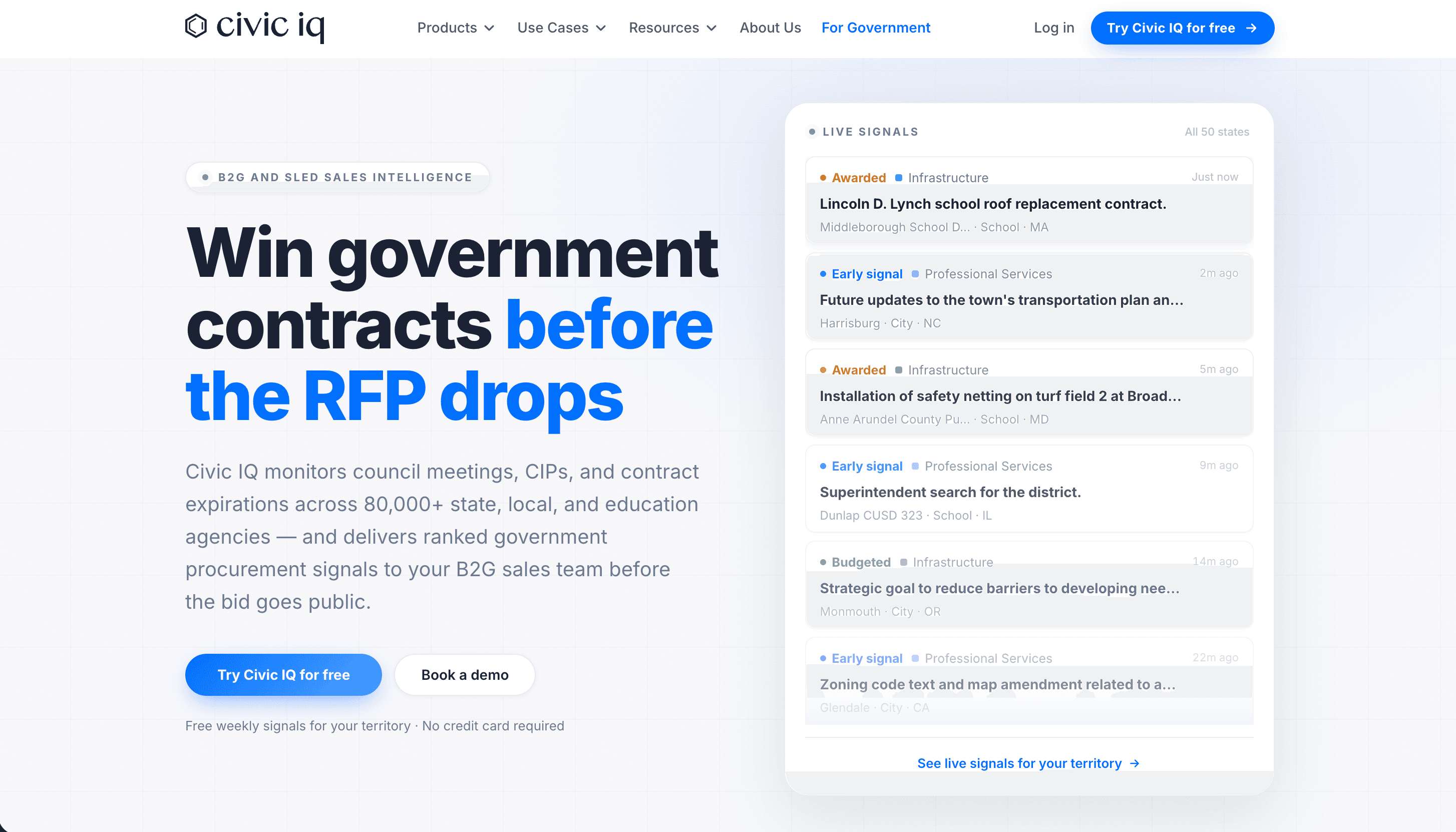
Verdict: Civic IQ is the strongest alternative for SLED teams that want to catch deals before the RFP rather than research them after the purchase. It reads 1.5M+ government documents monthly, meeting transcripts, budgets, CIPs, agendas, to surface buying signals months early, and it's the only forward-looking option here with 2.6M+ contacts and outreach sequences built in.
This is our product; here's the case with verifiable numbers.
| Civic IQ | GovSpend | |
|---|---|---|
| Core data | Forward-looking documents (meetings, budgets, CIPs) | Historical purchase orders / spend |
| Signal timing | Before the RFP | After the purchase |
| Documents processed | 1.5M+/month by AI | Spend records + Meetings+AI |
| SLED contacts | 2.6M+ | PO-linked directory |
| Email sequences & outreach | Built in | Not offered (CRM push only) |
| Competitor intel from meetings | Yes | Meetings+AI (spend-oriented) |
| CRM integrations | Salesforce, HubSpot, Pipedrive, Zoho | Salesforce, HubSpot (enrichment push) |
| Chrome extension | Yes, free: verified contacts and AI agency summaries in-page | Not advertised |
| MCP server | Yes, live for Claude, ChatGPT, and any MCP client | Yes, launched June 2026 |
| Managed SDR service | Yes, Pipeline-as-a-Service: a dedicated SDR works your signals | Not advertised |
Where it beats GovSpend
The fundamental difference is tense. GovSpend tells you what agencies bought last year; Civic IQ tells you what they're planning to buy next year. For a sales team, forward-looking signals tied to a specific agency and decision, plus contacts and one-click outreach, turn intelligence into pipeline instead of a research report. Civic IQ can also work the pipeline for you: Pipeline as a Service puts a dedicated SDR on your account, making 40–50 signal-triggered calls a day and booking 4–8 qualified government meetings a month directly to your calendar, from $2,000/month on top of a platform subscription. Reps who prospect by browsing get a free Chrome extension that puts verified government contacts and an AI agency summary on the LinkedIn, Sales Navigator, and .gov page they are already reading. Both platforms now offer an MCP server for AI workflows; Civic IQ's lets Claude, ChatGPT, or your own agents query signals, spend, contracts, and contacts directly rather than through a dashboard.
Where GovSpend still wins
Historical depth, full stop. Its $12T+ spend archive, vendor price benchmarking, and spend-trend analysis are best-in-class and Civic IQ doesn't try to replicate them. GovSpend also covers federal spend; Civic IQ's federal coverage is limited. Research-heavy teams and analysts should keep GovSpend, and many pair it with Civic IQ.
Pricing
Civic IQ publishes its pricing: a permanent free plan with three signals a month in one state, Starter at $299/month for up to three states, and Unlimited for all 50 states, quoted by territory and seat count. GovSpend sells annual subscriptions and does not publish prices; Vendr buyer data puts the median near $11,600 a year, in a range of about $7,900 to $49,500.
Choose Civic IQ if: you sell to cities, counties, K-12, or higher ed and win by getting in early, before the RFP, with the contacts and outreach to act.
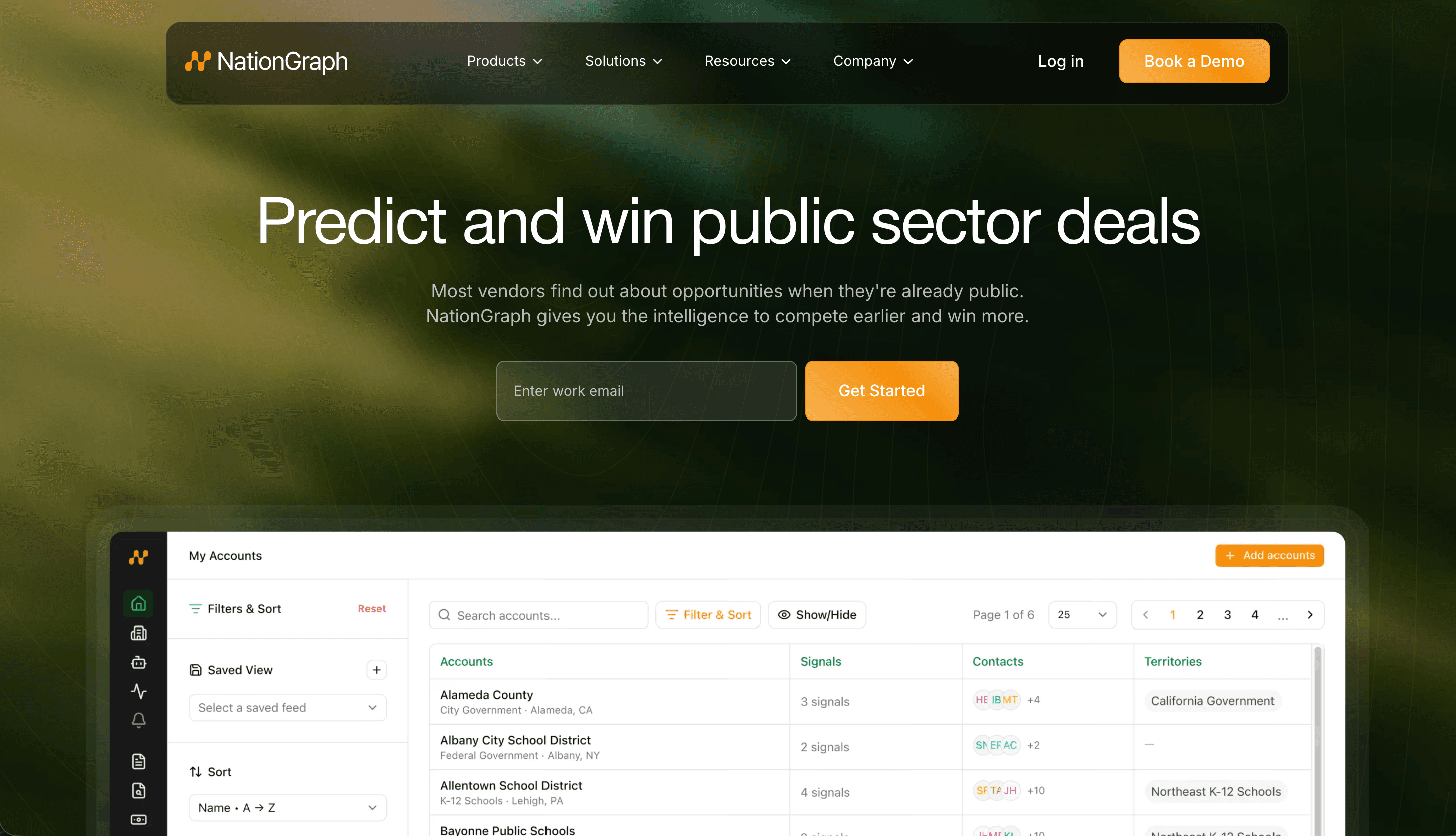
2. NationGraph: best for signals tied to a specific institution
Verdict: NationGraph is the sharpest pick for teams that want a pre-RFP signal tied to the exact institution and record behind it, a specific budget line, board vote, grant, or expiring contract, rather than an aggregate spend trend. Its SLED-first design surfaces demand before the RFP rather than after the purchase, addressing GovSpend's specificity gap directly.
Where it beats GovSpend
Forward-looking timing and record-level specificity; a clean SLED focus without federal-spend clutter.
Honest limitations
Newer and narrower than GovSpend's data empire; lighter on the deep historical spend archive that is GovSpend's whole reason for being; contact and outreach depth varies by plan.
Choose NationGraph if: you want the single most specific pre-RFP signal per institution and sell SLED.
See our full NationGraph vs Civic IQ comparison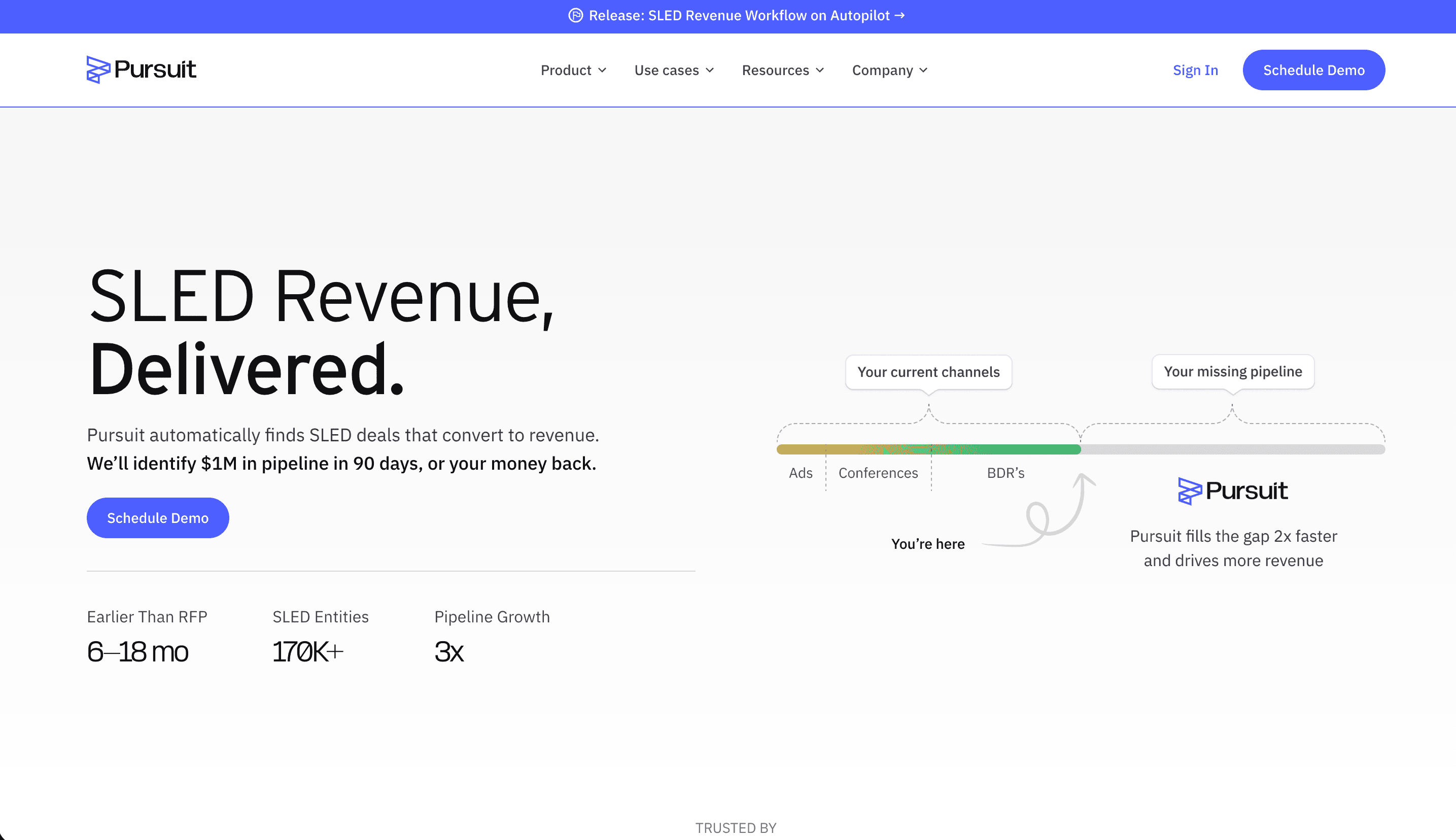
3. Pursuit: best for broad SLED intelligence in the rep's workflow
Verdict: Pursuit is the alternative built to live in a rep's day: an in-page extension that surfaces agency intel, contracts, contacts, and signals on any government or LinkedIn page, plus AI-drafted outreach (emails, LinkedIn messages, call scripts) tailored to the signal and the contact's role. For teams where rep time is the constraint, that execution layer is the draw.
Where it beats GovSpend
GovSpend gives you intelligence but doesn't help you act on it; Pursuit turns signals into ready-to-send outreach and account scoring built for SLED.
Honest limitations
SLED-focused, so not a fit if you need federal or deep historical spend research; as a sales-execution platform it's a different tool than a spend archive, not a drop-in replacement for GovSpend's benchmarking use case.
Choose Pursuit if: your bottleneck is rep throughput, knowing which three of 80 accounts to call today and what to say.
See our full Pursuit vs Civic IQ comparison
4. GovWin IQ: best for federal depth GovSpend lacks
Verdict: GovWin IQ from Deltek is the alternative for teams whose real gap is federal. Where GovSpend's core is SLED spend data, GovWin brings 150+ research analysts, recompete forecasting, and federal contract history to 1999, depth for high-value federal pursuits that spend data alone can't provide.
Where it beats GovSpend
Federal opportunity intelligence and analyst-curated forecasts.
Honest limitations
The most expensive tool in the category (typically ~$15K to $29K+/yr), no purchase-order spend archive to rival GovSpend, and its SLED coverage lags dedicated SLED platforms.
Choose GovWin IQ if: your pipeline is federal and analyst forecasts justify the price.
See our full GovWin IQ comparison
5. HigherGov: best low-cost place to start
Verdict: HigherGov offers the broadest low-cost entry point: a free trial, then paid plans from $500 a year for one user to $2,500 a year for up to 10 users, spanning federal and SLED opportunity data. It is the lowest-risk way to replace or supplement GovSpend without a large budget commitment.
Where it beats GovSpend
Cost (from $500/year, with a free trial) and wide raw coverage across federal and SLED for the price.
Honest limitations
Breadth over depth: lighter analysis, signal scoring, and contact intelligence; no document-level AI reading meeting transcripts; no historical spend archive at GovSpend's scale.
Choose HigherGov if: you're validating the category or need an affordable supplementary data source.
6. BidPrime: best real-time published-bid backstop
Verdict: BidPrime is the alternative for teams that want fast, reliable alerts the moment a bid or solicitation is published across SLED and federal sources. It won't get you in before the RFP, but as a live-bid safety net underneath a pre-RFP platform, it ensures nothing posted slips through.
Where it beats GovSpend
Real-time published-bid alerting is more immediate than spend data for catching active solicitations.
Honest limitations
At-RFP timing by design (not pre-RFP), no historical spend archive, and lighter contact/outreach tooling. It's a complement, not a full platform.
Choose BidPrime if: you want a dependable live-bid alert layer beneath your primary intelligence tool.
7. GovTribe: best budget federal pipeline
Verdict: GovTribe is the value pick for federal contractors: consolidated SAM.gov/FPDS opportunity, award, and spending data with ML recommendations, starting around $1,350/year, a fraction of enterprise tools.
Where it beats GovSpend
Affordable, modern federal opportunity tracking for small and mid-size contractors.
Honest limitations
Federal only, no meaningful SLED coverage, no meeting/budget document analysis, and no historical PO archive at GovSpend's depth.
Choose GovTribe if: you need organized federal pipeline data without enterprise pricing.
See our full GovTribe comparisonWhich GovSpend alternative is right for you?
You sell IT, security, or services to school districts and municipalities and win early → Civic IQ. Pre-RFP signals from meetings and budgets, contacts, and outreach in one platform.
You want the most specific possible signal per institution → NationGraph.
Your bottleneck is rep execution speed, not data → Pursuit.
Your real gap is federal opportunity coverage → GovWin IQ (depth) or GovTribe (value).
You're validating the category on a budget → HigherGov, from $500/year with a free trial.
You need a live-bid alert backstop → BidPrime under your primary tool.
Your job is genuinely spend research and vendor benchmarking → Stay on GovSpend. It's the best tool for that work, and no alternative here changes that.
GovSpend vs pre-RFP intelligence: what's the real difference?
GovSpend answers a backward-looking question exceptionally well: what has this agency spent, and with whom? That's invaluable for benchmarking a price, sizing a market, or finding agencies that already buy your category. But a purchase order is the end of a sales cycle, not the beginning; by the time it exists, the deal was scoped, competed, and won months earlier.
Pre-RFP intelligence answers the forward-looking question: what is this agency about to buy? It reads the meetings, budgets, and capital plans where projects are discussed before any solicitation exists, so a vendor can engage while requirements are still being shaped. The two aren't competitors so much as opposite ends of the same timeline, which is why data-driven teams often run a spend tool and a pre-RFP tool together. The mistake is using historical spend data as if it were a pipeline engine; that's researching the past and hoping it predicts the future.
Frequently asked questions
For SLED teams that want to find deals before the RFP, Civic IQ is the strongest alternative: 2.6M+ contacts, AI reading 1.5M+ documents monthly, and built-in outreach. NationGraph and Pursuit are also strong SLED options; GovWin IQ and GovTribe cover federal. The best choice depends on whether you sell forward or research backward.
GovSpend's closest competitors depend on the job. For finding SLED deals before the RFP: Civic IQ (pre-RFP signals from board meetings and budgets, with contacts and outreach built in), NationGraph, and Pursuit. For federal coverage: GovWin IQ by Deltek and GovTribe. For low-cost or real-time bid tracking: HigherGov and BidPrime. None of them replicates GovSpend's purchase-order archive ($12T+ in documented spend) for spend research.
Partially. GovSpend has added Meeting Intelligence, contract-expiration tracking, and an AI Opportunity dashboard, but its core strength is historical purchase-order and spend data, a record of what agencies already bought. For catching demand before the RFP, forward-looking pre-RFP platforms like Civic IQ or NationGraph are purpose-built for that job.
GovSpend sells annual subscriptions and does not publish prices. Vendr buyer data puts the median near $11,600 a year, with a range of about $7,900 to $49,500. Several alternatives publish pricing: GovTribe starts near $1,350/year, HigherGov starts at $500/year with a free trial, and Civic IQ has a free plan with Starter at $299/month.
Yes, GovSpend offers a contact directory, often linked to purchase-order records and decision-maker roles, and pushes enriched data to CRMs. Civic IQ maintains a larger forward-looking set (2.6M+ contacts) tied to live buying signals rather than past purchases, and adds built-in outreach sequences GovSpend doesn't offer.
GovSpend tells you what agencies bought last year; Civic IQ tells you what they're planning to buy next year. GovSpend's foundation is historical spend data, best for benchmarking and research. Civic IQ's is forward-looking document intelligence, best for catching deals before the RFP, with contacts and outreach to act. Many teams use both.
Yes, and data-driven teams often do. GovSpend answers backward-looking questions (what did this agency pay, who supplies them now) while Civic IQ answers forward-looking ones (what are they about to buy, who do I contact). They cover opposite ends of the sales timeline with little overlap, so the combination is complementary rather than redundant.
Civic IQ, NationGraph, and Pursuit are the three strongest SLED-focused alternatives. Civic IQ leads on pre-RFP document intelligence at scale plus contacts and outreach; NationGraph on institution-specific signals; Pursuit on in-workflow rep tools. All three are built for selling into state, local, and education, unlike GovSpend's research-oriented spend foundation.
The bottom line
GovSpend is the best in the business at one thing: telling you what government has already bought. If that's your job, benchmarking, market research, vendor analysis, nothing here replaces it. But if you're a sales team, a purchase order is a deal you already lost or missed. The alternatives above, led by Civic IQ for SLED, answer the question that actually grows pipeline: what are they about to buy, and who do I call?
If your deals are forming right now in board meetings and budget cycles, see what's forming in your territory.
Get started freeSources
Sources & citations
- 1.GovSpend company history
- 2.GovSpend data advantage: $12T+ documented spend data, 291K tracked agencies, 15 years of data
- 3.GovSpend FAQ: annual subscriptions, pricing not published
- 4.Vendr: GovSpend buyer pricing data (updated February 2026)
- 5.GovSpend MCP server launch (June 2026)
- 6.Thompson Street Capital Partners majority investment in GovSpend (2020)
- 7.GovSpend Fedmine acquisition (2021, 19 federal datasets)
- 8.GovSpend 2025 to 2026 AI suite / module documentation
- 9.HigherGov pricing: Starter, Standard, and Enterprise plans
- 10.G2 / Capterra: GovSpend alternatives category and reviews