
6 Best Starbridge Alternatives & Competitors in 2026 (SLED & B2G Sales)
The short answer
Starbridge (starbridge.ai) is a broad, self-serve B2G go-to-market suite for SLED and education sellers. It rewards teams with a RevOps owner to configure it, and it's SLED-only. If you want the deepest pre-RFP signal with hands-on configuration, Civic IQ. For historical spend depth, GovSpend. For federal coverage Starbridge lacks, GovWin IQ. Match the alternative to whether you want breadth, depth, spend, or federal.
Starbridge is a real platform solving real problems, and it deserves an honest comparison. Its bet is breadth: one self-serve suite touching every stage of public-sector go-to-market, from first buying signal to submitted proposal, with a deep contact database and native CRM sync. For a well-resourced enterprise team that wants to run everything itself in one tool, that's a genuine strength.
Teams look for alternatives for four consistent reasons: they want a deeper, better-tuned pre-RFP signal rather than breadth across many features; they want hands-on help configuring and working the pipeline instead of a self-serve tool; they need federal coverage Starbridge (SLED-only) doesn't offer; or they want spend-research depth. This guide compares the six strongest Starbridge alternatives and competitors in 2026, organized by which of those you're after. We build one of them (Civic IQ, #1 for pre-RFP depth, and we'll show our work and name where Starbridge and others beat us).
Starbridge competitors and alternatives at a glance
Starbridge's main competitors in SLED and B2G sales intelligence are Civic IQ, GovSpend, GovWin IQ (Deltek), Bloomberg Government, GovDash / GovSignals, and Burbio. Each competes on a different axis: Civic IQ on pre-RFP board-meeting signals with a managed pipeline, GovSpend on historical purchase-order data, GovWin IQ on federal coverage and analyst forecasts, Bloomberg Government on federal policy, GovDash and GovSignals on AI proposal writing, and Burbio on K-12 document monitoring.
| Platform | Best for | Model | Market | Standout capability |
|---|---|---|---|---|
| 1.Civic IQ | Deepest pre-RFP signal + managed pipeline | Software + managed service | SLED | Board-meeting signals 6–18 mo pre-RFP, tuned to your offering; free Chrome extension; Pipeline-as-a-Service |
| 2.GovSpend | Historical spend + benchmarking | Self-serve | SLED + Federal | $12T+ in documented spend; line-level spend data |
| 3.GovWin IQ | Federal depth + analyst forecasts | Software + analysts | Federal + SLED | 150+ analysts; multi-year forecasts; federal coverage |
| 4.Bloomberg Government | Policy-driven federal BD | Self-serve | Federal | Ties appropriations/legislation to procurement |
| 5.GovDash / GovSignals | AI proposal + capture | Software | Federal + SLED | Compliance-grade AI proposal writing |
| 6.Burbio | Granular K-12 document monitoring | Self-serve | K-12 | District-level agenda/document tracking |
| Starbridge (reference) | Broad self-serve B2G suite | Self-serve | SLED only | Broad module set; SLED-only coverage |
Why teams look for a Starbridge alternative
Starbridge is a broad self-serve suite that covers a lot of go-to-market surface area for SLED sellers.
The reasons teams still evaluate alternatives cluster into four:
Depth vs breadth
Starbridge treats pre-RFP signals as one feature among many. Teams whose entire strategy is getting in before the RFP often want a platform where that signal is the core product, tuned to their specific offering to suppress noise, rather than one module in a wide suite.
Self-serve vs done-for-you
Unlocking Starbridge's value typically requires a technical admin or RevOps owner to configure ICPs, saved searches, signal filters, and CRM mappings. Outreach runs the same way: Sequences, a paid add-on since September 2026, sends from each rep's own inbox. Teams without a RevOps function want configuration and pipeline handled for them.
Federal coverage
Starbridge is SLED-only. Teams with federal accounts need a second platform or a different tool entirely.
Pricing and stage
Starbridge is premium-priced with no free tier and is better suited to established enterprise teams than early-stage companies.
If you're a well-resourced enterprise SLED team that wants one broad self-serve suite, none of these may apply and Starbridge is a fine choice. If any do, here are your options.
Methodology
How we evaluated these alternatives
We scored each platform on five criteria: signal depth and timing (how early, how well-tuned to your product), service model (self-serve vs configured-and-managed for you), market fit (SLED, federal, or both), contact and spend intelligence, and cost/stage fit. Sources: vendor documentation, published pricing, G2 reviews, and our own competitive testing. Where we're the vendor, we say so, and we concede Starbridge's genuine advantages rather than pretending they don't exist.
1. Civic IQ: best for pre-RFP depth and a managed pipeline
Verdict: Civic IQ is the alternative for teams whose priority is the earliest, best-tuned pre-RFP signal rather than the widest tool suite, and who want that intelligence configured and worked for them. Where Starbridge bets on breadth across many self-serve modules, Civic IQ bets on depth: board-meeting signals across 100,000+ SLED agencies, delivered 6–18 months before RFPs publish, scored against your specific offering, and backed by a managed Pipeline-as-a-Service.
This is our product; here's the honest comparison.
| Civic IQ | Starbridge | |
|---|---|---|
| Core bet | Depth (pre-RFP signal, tuned) | Breadth (all-in-one suite) |
| Service model | Software + managed pipeline service | Self-serve (needs RevOps owner) |
| Pre-RFP signal | Core product, tuned to your offering | One module among many |
| Built-in outbound | Yes (managed SDR / sequences) | Yes, Sequences (paid add-on, since September 2026) |
| Market | SLED | SLED only |
| Contact data | Pulled + verified from agency sources | 98% email accuracy (advertised) |
| CRM integrations | Salesforce, HubSpot, Apollo, Instantly, ZeroBounce | Salesforce, HubSpot, Apollo, Outreach |
| Pricing | Free; Starter $299/mo; Unlimited quoted | Premium, no free tier |
| Chrome extension | Yes, free: verified contacts and AI agency summaries in-page | Not advertised |
| MCP server | Yes, live for Claude, ChatGPT, and any MCP client | Yes, launched June 2026 |
| Managed SDR service | Yes, Pipeline-as-a-Service: a dedicated SDR works your signals | Not offered |
Where it beats Starbridge
The pre-RFP signal is the whole product, not one feature, scored against your product to suppress noise, and it comes configured for you. Civic IQ's Pipeline-as-a-Service sources and qualifies contacts against active signals so teams get qualified opportunities without adding headcount, where Starbridge expects your team to configure and run outreach itself. Published pricing with a free plan suits teams that don't want premium enterprise pricing. Reps who prospect by browsing get a free Chrome extension that puts verified government contacts and an AI agency summary on the LinkedIn, Sales Navigator, and .gov page they are already reading. Both platforms now offer an MCP server for AI workflows; Civic IQ's lets Claude, ChatGPT, or your own agents query signals, spend, contracts, and contacts directly rather than through a dashboard.
Where Starbridge still wins
Breadth. Starbridge covers more go-to-market surface area in one self-serve tool, so if you want a single platform your own RevOps team runs end-to-end, it's the stronger fit.
Pricing
Civic IQ publishes its pricing: a permanent free plan with three signals a month in one state, Starter at $299/month for up to three states, and Unlimited for all 50 states, quoted by territory and seat count. That is a direct contrast to Starbridge's premium, no-free-tier model.
Choose Civic IQ if: your priority is the deepest pre-RFP signal, tuned to your offering, with a team that helps configure it and works the pipeline for you.
2. GovSpend: best for historical spend and benchmarking
Verdict: GovSpend is the alternative for teams that want unmatched depth of actual purchase-order and spending data, the hidden 80% of discretionary government spending most platforms miss. Its line-level PO data shows what agencies bought, from whom, and at what price, and it now pairs that with AI Search and Meeting Intelligence.
Where it beats Starbridge
Deeper historical spend and purchase-order data, plus federal coverage (via Fedmine's 19 sources) that Starbridge, being SLED-only, lacks.
Honest limitations
Its foundation is backward-looking spend data rather than forward pre-RFP signals; it's self-serve; and it's a research-oriented tool more than a managed sales motion.
Choose GovSpend if: spend research, vendor benchmarking, and pricing intelligence are your priority, or you need federal spend coverage.
See our full GovSpend comparison
3. GovWin IQ: best for federal depth and analyst forecasts
Verdict: GovWin IQ from Deltek is the alternative for teams that need federal coverage and analyst-curated intelligence Starbridge doesn't offer: 150+ in-house analysts who interview procurement officials and publish multi-year forecasts, across both federal and SLED.
Where it beats Starbridge
Federal coverage and human analyst forecasting; deep contract history; enterprise BD depth.
Honest limitations
The most expensive tool in the category (~$15K to $29K+/yr); some users note its notifications can lag 24 to 48 hours and its core workflow alerts after an opportunity posts, later than a pre-RFP signal; SLED coverage lags dedicated SLED platforms.
Choose GovWin IQ if: you pursue federal programs and value analyst forecasts over AI-native signal speed.
See our full GovWin IQ comparison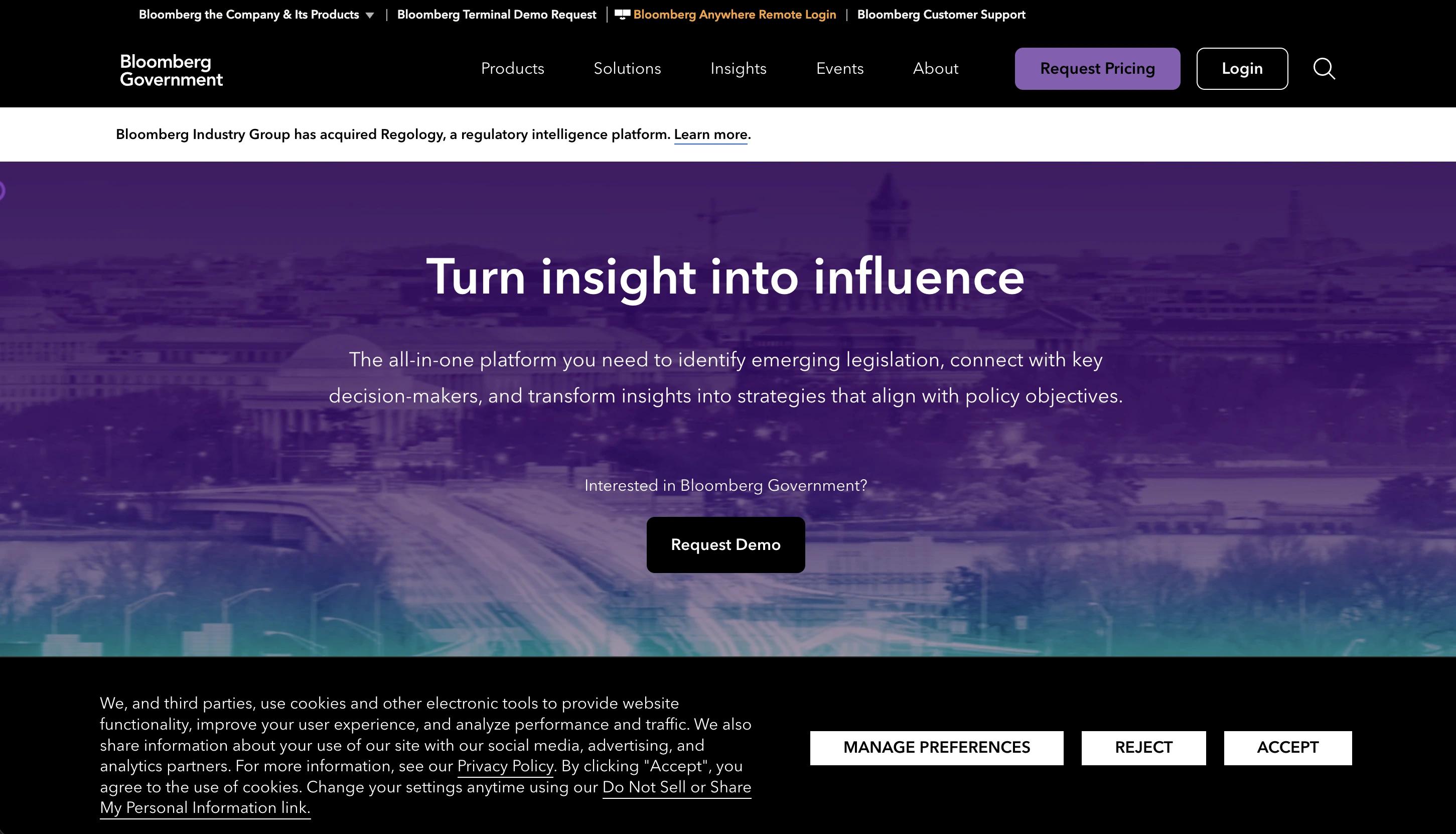
4. Bloomberg Government: best for policy-driven federal BD
Verdict: BGOV is the alternative for teams whose deals depend on understanding what Congress funds before agencies buy: federal contract intelligence combined with real-time legislative, regulatory, and appropriations analysis, the upstream policy context neither Starbridge nor most SLED tools provide.
Where it beats Starbridge
Federal policy and appropriations intelligence; unmatched for policy-sensitive markets.
Honest limitations
Enterprise pricing, federal focus, no SLED signal engine or managed pipeline; a complement to opportunity tracking, not a SLED sales tool.
Choose Bloomberg Government if: you're a federal contractor where legislative intelligence drives BD.
5. GovDash / GovSignals: best for AI proposal and capture
Verdict: GovDash and GovSignals are the alternatives for teams whose bottleneck is proposal-heavy work rather than pre-RFP prospecting. Both go deeper than Starbridge's RFP module on compliance-grade AI proposal writing: GovSignals generates fully traceable, auditable proposals with FedRAMP High/DoD IL5 posture; GovDash covers the full federal capture-to-contract lifecycle.
Where it beats Starbridge
Proposal writing is core, not an add-on, deeper and more secure than Starbridge's AI proposal feature.
Honest limitations
Federal-first with lighter SLED account-based selling; less focused on pre-RFP outbound than Starbridge or Civic IQ.
Choose GovDash / GovSignals if: writing and winning proposals, not finding signals, is your primary challenge.
See our government proposal software guide6. Burbio: best for granular K-12 document monitoring
Verdict: Burbio is the specialist alternative for edtech teams that want document-level K-12 monitoring at the individual district level, deeper granularity in that specific niche than a broad suite provides.
Where it beats Starbridge
District-level K-12 document depth for edtech-specific prospecting.
Honest limitations
Narrow to K-12 document monitoring; no broad SLED/federal coverage, contact database, or managed pipeline; a supplement, not a full platform.
Choose Burbio if: you sell edtech and want the most granular K-12 district document signal.
Which Starbridge alternative is right for you?
You want the deepest pre-RFP signal, tuned to your product, worked for you → Civic IQ.
You want historical spend depth or federal spend coverage → GovSpend.
You pursue federal programs and value analyst forecasts → GovWin IQ.
Your deals hinge on federal policy and appropriations → Bloomberg Government.
Writing and winning proposals is your primary challenge → GovDash or GovSignals.
You sell edtech and want district-level K-12 depth → Burbio.
Starbridge vs Civic IQ: breadth vs depth
Starbridge and Civic IQ are both B2G sales-intelligence platforms, but they bet on opposite things. Starbridge bets on breadth: an all-in-one, self-serve go-to-market suite spanning signals, contacts, spend research, contract-vehicle access, and AI proposal drafting, run by your own team. Civic IQ bets on depth: pre-RFP board-meeting signals as the core product, tuned to each customer's offering, delivered 6–18 months before RFPs publish, and backed by hands-on signal configuration plus a managed pipeline service.
The honest verdict: choose Starbridge for the widest tool suite your team will run itself; choose Civic IQ for the deepest pre-RFP signal with the intelligence layer configured and worked for you. For a full head-to-head, see Starbridge vs Civic IQ.
Frequently asked questions
For teams whose priority is the earliest, best-tuned pre-RFP signal with hands-on support, Civic IQ is the closest alternative. GovSpend leads for historical spend depth and GovWin IQ for federal analyst forecasts. The best choice depends on whether you want signal depth, spend data, federal coverage, or a broad self-serve suite.
Starbridge.ai's closest competitors in SLED and B2G sales intelligence are Civic IQ, for pre-RFP board-meeting signals with a managed SDR pipeline; GovSpend, for historical purchase-order and spend data; and GovWin IQ by Deltek, for federal coverage and analyst forecasts. Bloomberg Government, GovDash / GovSignals, and Burbio compete in narrower niches: federal policy, AI proposal writing, and K-12 document monitoring.
Starbridge is a broad self-serve suite covering many go-to-market features; Civic IQ is a focused pre-RFP intelligence platform where board-meeting signal detection is the core product, tuned to your offering, and backed by a managed pipeline service. Starbridge bets on breadth your team runs itself; Civic IQ bets on depth configured and worked for you.
No, Starbridge is SLED-only, built for state, local, K-12, and higher education. Teams with federal accounts need a separate platform: GovWin IQ for analyst-backed federal intelligence, GovSpend for federal spend data via Fedmine, or Bloomberg Government for federal policy and appropriations context.
It depends on whether you'll use the breadth. Starbridge is premium-priced with no free tier, and unlocking it assumes a RevOps owner to configure ICPs, saved searches, and CRM mappings. For early-stage teams, teams without RevOps capacity, or teams whose single priority is pre-RFP depth, a focused or managed alternative usually delivers more value per dollar.
Yes. Starbridge Sequences became generally available in September 2026: multi-step email sent from each rep's own inbox and logged to Salesforce or HubSpot, sold as a paid add-on module. Civic IQ differs in who does the work: alongside its own sequences, it offers Pipeline as a Service, a managed SDR team that works the signals for you, which Starbridge does not offer.
Starbridge advertises 98% email accuracy. Civic IQ pulls and continuously verifies contacts directly from agency websites, staff directories, and meeting documents. For SLED specifically, both outperform general-purpose B2B databases that rely on LinkedIn scraping and see 15 to 25% bounce rates.
Some teams do, though there's meaningful overlap since both cover SLED pre-RFP signals and contacts. More often teams choose one based on model: Starbridge if you want a broad self-serve suite your team configures, Civic IQ if you want the deepest tuned pre-RFP signal plus a managed pipeline service. The decision is usually breadth-and-self-serve versus depth-and-managed.
The bottom line
If you want one self-serve platform covering the full go-to-market motion and you have the RevOps capacity to run it, Starbridge is a legitimate choice. But breadth and depth are different bets. If your entire strategy is getting in before the RFP, with a signal tuned to your product and a team that helps you work it, that's what Civic IQ is built for.
If you want to see which agencies are evaluating vendors in your territory right now, see what's forming.
Get started freeSources
Sources & citations
- 1.Starbridge public materials: module set, coverage, advertised contact accuracy
- 2.G2: Starbridge reviews (self-serve configuration)
- 3.Starbridge help center: Sequences general availability (September 2026, paid add-on) and MCP server release (June 2026)
- 4.GovSpend: $12T+ documented spend data, Fedmine federal coverage
- 5.GovWin IQ: analyst team, federal coverage
- 6.GovDash/GovSignals, Burbio vendor documentation