The government procurement intelligence market has changed
Five years ago, selling into government meant searching SAM.gov, subscribing to a bid notification service, and hoping you found solicitations before your competitors did. That approach still works — if you're comfortable competing on the same terms as everyone else, responding to RFPs alongside dozens of other vendors who saw the same posting on the same day.
In 2026, the landscape looks fundamentally different. A new generation of platforms uses AI to process millions of government documents — meeting transcripts, budgets, planning reports, board agendas — and surfaces buying signals months before a formal solicitation is published. At the same time, established players like GovWin IQ have been adding AI capabilities to their analyst-driven models, and newer entrants like GovDash are using AI to automate the proposal writing process itself.
The result is that procurement intelligence is no longer one category. It's at least three: pre-RFP signal detection, opportunity tracking, and proposal automation. The right platform for your team depends on which problem you're actually trying to solve, which agencies you sell into, and where your current sales process breaks down. This guide breaks down the five most relevant platforms for SLED and federal sales teams, with an honest look at what each one does well and where it falls short.
Different tools solve different problems
How we evaluated these platforms
We're transparent: Civic IQ is our product, and we have a point of view. But we've done our homework. We evaluated each platform based on publicly available information, product demos, user feedback, and direct testing where possible. Here are the criteria we used:
Pre-RFP intelligence depth
Can the platform surface buying signals before an RFP is published? How early? From what sources? This is the single biggest differentiator in the market.
Agency coverage breadth
How many agencies does the platform monitor, and in which markets (federal, state, local, education)? Coverage gaps mean missed opportunities.
Contact database quality
How many government decision-maker contacts does the platform offer? Are contacts linked to live buying signals or just static directory entries?
Sales execution tools
Does the platform include built-in outreach, email sequences, pipeline management, and CRM integration? Or do you need separate tools to act on the intelligence?
AI capabilities
How is AI used — for document analysis, proposal writing, search, or something else? Is it core to the platform or a bolt-on feature?
Ease of adoption
How quickly can a team get value? Does the platform require lengthy implementation, data migration, or training?
Most teams enter deals too late
By the time a solicitation shows up in any of the tools reviewed below, the agency has already defined requirements and identified preferred vendors. You're not early. You're late.
- Agency publishes an RFP
- You find it alongside dozens of vendors
- You respond without prior relationships
- Low win rate on cold submissions
- Agency discusses a need in a meeting
- AI flags the signal and scores it
- You build a relationship early
- You help shape the requirements
The 5 best government contract intelligence platforms
Each platform ranked and reviewed in detail, with honest pros and cons.
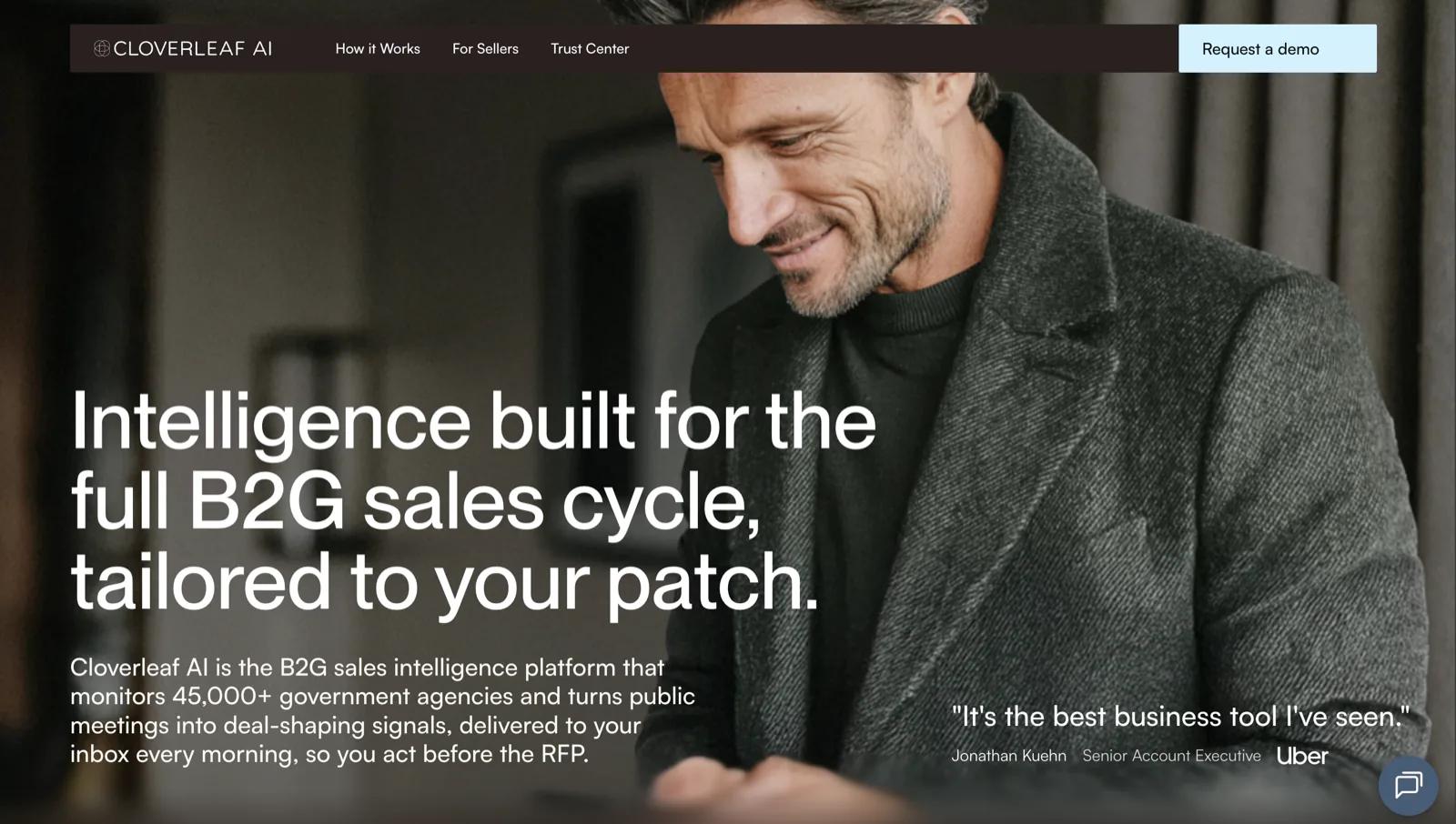
Civic IQ
Best for SLED Pre-RFP IntelligenceCivic IQ is built around a simple thesis: by the time an RFP is published, you've already lost. The platform uses AI to read 1.5 million+ government documents every month — council meeting transcripts, school board agendas, county budget hearings, planning commission reports — and extracts buying signals that indicate an agency is moving toward a purchase. These signals surface 6 to 18 months before any formal solicitation, giving sales teams time to build relationships, understand requirements, and position themselves as the preferred vendor.
What sets Civic IQ apart from other platforms that have started adding 'AI features' is that AI isn't an add-on — it's the foundation. The platform was designed from the ground up around document intelligence, not retrofitted onto a legacy database. It covers 76,000+ SLED agencies and maintains a database of 2.6 million+ government decision-maker contacts, each linked to the buying signals detected in their agency. And unlike pure intelligence platforms, Civic IQ includes built-in sales execution tools: email sequences, pipeline management, and native CRM integrations with Salesforce, HubSpot, Pipedrive, and Zoho.
The main limitation is federal coverage. Civic IQ is purpose-built for state, local, and education markets. If your pipeline depends heavily on federal contracts, you'll want to pair Civic IQ with a federal-focused tool like GovWin or GovTribe. But for SLED-focused teams, no other platform combines pre-RFP intelligence, contacts, and sales tools in a single workflow the way Civic IQ does.
- Pre-RFP signals from AI document analysis 6–18 months before RFPs
- Largest SLED contact database (2.6M+) linked to live buying signals
- Built-in email sequences and pipeline management
- Native CRM integrations (Salesforce, HubSpot, Pipedrive, Zoho)
- Competitor intelligence from actual government meeting transcripts
- Fast onboarding — most teams see signals within hours
- AI-first architecture, not bolted onto a legacy database
- Limited federal coverage — SLED-focused by design
- No AI proposal writing capabilities (yet)
- No recompete forecasting or incumbent analysis
- Newer platform with less historical data depth than established players
GovWin IQ
Best for Federal Analyst IntelligenceGovWin IQ is the government procurement intelligence arm of Deltek, owned by Roper Technologies (NYSE: ROP, $2.8B acquisition in 2016). Built through acquisitions of INPUT, Federal Sources, Centurion, and Onvia ($70M, 2017), GovWin has the longest track record in the space. With 150+ research analysts who interview procurement officers, attend industry days, and forecast recompetes, the platform provides human-curated intelligence on 46 million+ federal contract transactions, 100,000+ SLED organizations, and 25,000+ analyst-tracked opportunities. GovWin customers have collectively won more than $200 billion in government contracts.
Where GovWin shows its age is in SLED coverage and sales execution. The platform has around 530,000 SLED contacts compared to Civic IQ's 2.6 million+. It doesn't analyze government meeting transcripts for pre-RFP signals, and it doesn't include built-in sales tools like email sequences or outreach campaigns. Deltek is investing in AI through Dela — their AI-powered business companion that brings Smart Fit scores, document summarization, Smart Search, and real-time opportunity chat — and is building full AI proposal capabilities combining GovWin IQ + Costpoint ERP + Dela AI.
GovWin pricing is enterprise-grade and not publicly listed — it's typically the most expensive platform in this space, with separate packages for Federal and SLED markets. For large federal contractors with dedicated BD teams and an existing Deltek ecosystem (Costpoint, Vantagepoint), GovWin remains hard to beat. For SLED-focused teams or smaller organizations, the alternatives in this list offer broader coverage and more integrated sales tools at a different price point.
- Deepest federal intelligence with analyst-curated insights
- Recompete forecasting and incumbent analysis for federal contracts
- 30+ years of historical federal contract data
- Canadian government market coverage
- AI proposal capabilities coming via Dela AI (2026)
- Seamless integration with Deltek ERP ecosystem
- Significantly smaller SLED contact database (~530K vs 2.6M+)
- No built-in sales execution tools (email, outreach, pipeline)
- No AI meeting transcript analysis or pre-RFP signal detection at scale
- Typically the most expensive option, geared toward enterprise
- CRM integration limited to Deltek native; Salesforce requires third-party tools
vs Civic IQ
GovWin's 150 analysts go deep on federal, but no analyst team can read every document from 90,000+ government entities. Civic IQ processes 1.5M+ documents monthly using AI and has nearly 5x more SLED contacts. GovWin excels at federal depth; Civic IQ excels at SLED breadth and speed.
GovSpend
Best for Historical Spending DataGovSpend was founded in 2011 by Jack Siney and Jeffrey Rubenstein — Rubenstein created the initial spending database while serving as an auxiliary police officer, motivated by a desire to bring transparency to public sector spending. Now backed by Thompson Street Capital Partners (acquired January 2021) and headquartered in Deerfield Beach, Florida, GovSpend has built the deepest government purchase order database in the industry: $17.6 trillion in total spending captured, with $3.8 trillion from the last 12 months alone. In 2021, they also acquired Fedmine (founded 2004), bringing 19 federal datasets into the platform.
GovSpend has been one of the most aggressive platforms in adding AI. Their 2025-2026 suite includes AI Bid Summaries, Contracts+AI, Meetings+AI, Spending+AI, AI Notebook, and AI Search — all well-integrated across five modules. They're bringing AI Search to Slack and Microsoft Copilot, and investing in AI Data Operations for automated data sourcing and enrichment. These are genuinely useful capabilities, but they sit on a foundation built around historical spending data — fundamentally different from Civic IQ's AI-first approach to forward-looking document intelligence.
If your primary use case is market research, vendor benchmarking, or understanding spending patterns, GovSpend is the best tool for the job. Led by CEO Jeff Rubenstein and President Nate Haskins, the platform continues to deepen its spending coverage while expanding AI capabilities. If your primary use case is finding agencies planning to buy before the RFP drops, Civic IQ is purpose-built for that. Many data-driven teams use both.
- Deepest historical PO-level spending data in the market
- Vendor pricing benchmarks for competitive positioning
- Federal coverage via Fedmine acquisition (19 datasets)
- Well-integrated AI features across all five modules
- Co-op and contract vehicle tracking
- Deep Salesforce and HubSpot integration with full module sync
- Foundation is backward-looking (what was bought, not what's planned)
- No built-in sales execution tools (email sequences, outreach)
- Contacts tied to historical POs, not current decision-maker roles
- AI meeting intelligence is an add-on, not the core architecture
- No Pipedrive or Zoho CRM integration
vs Civic IQ
GovSpend tells you what agencies bought last year. Civic IQ tells you what they're planning to buy next year. GovSpend has deeper spending data; Civic IQ has more contacts (2.6M+ vs PO-linked) and includes the sales tools to act on what you find. Different questions, different platforms.
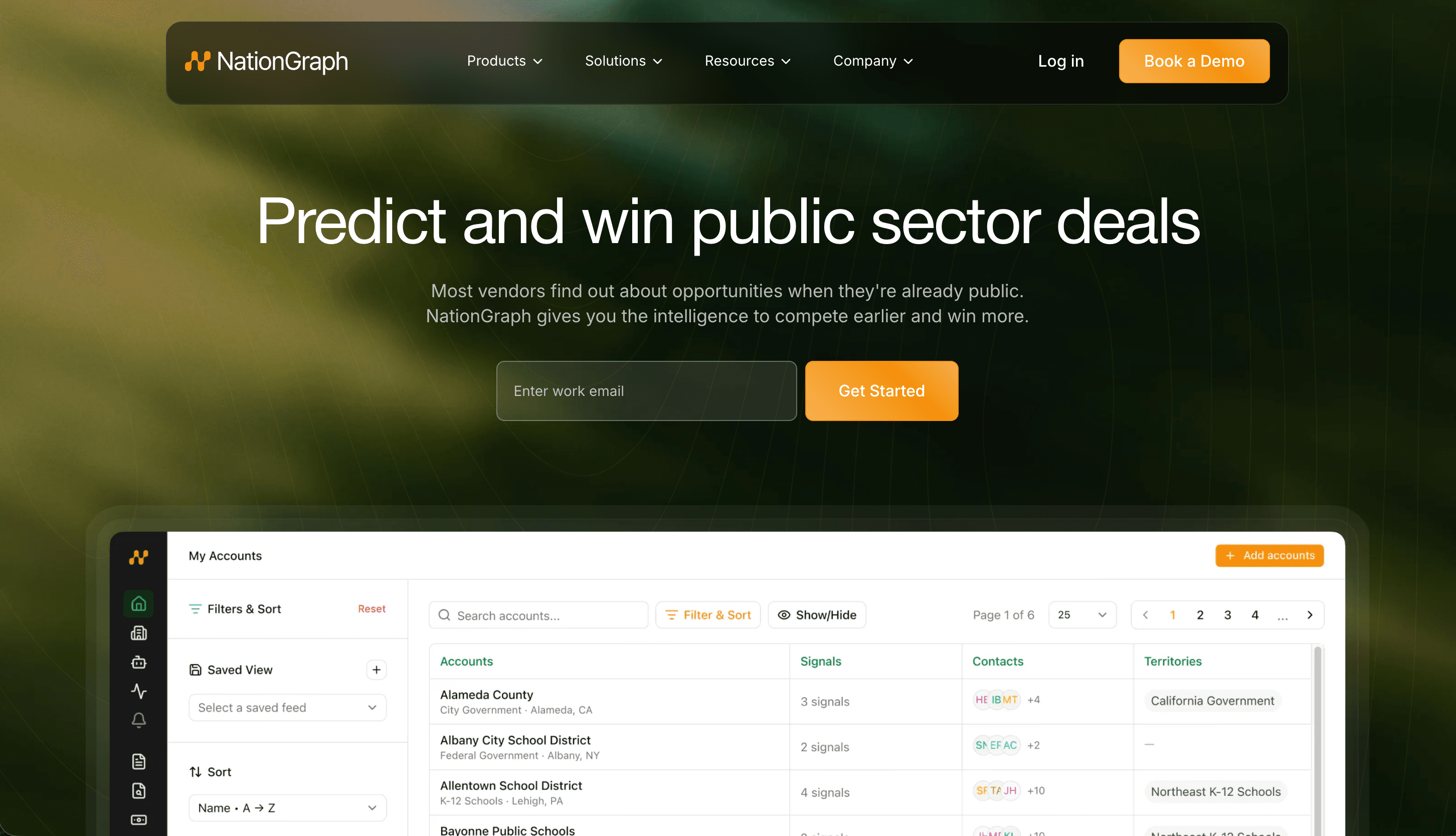
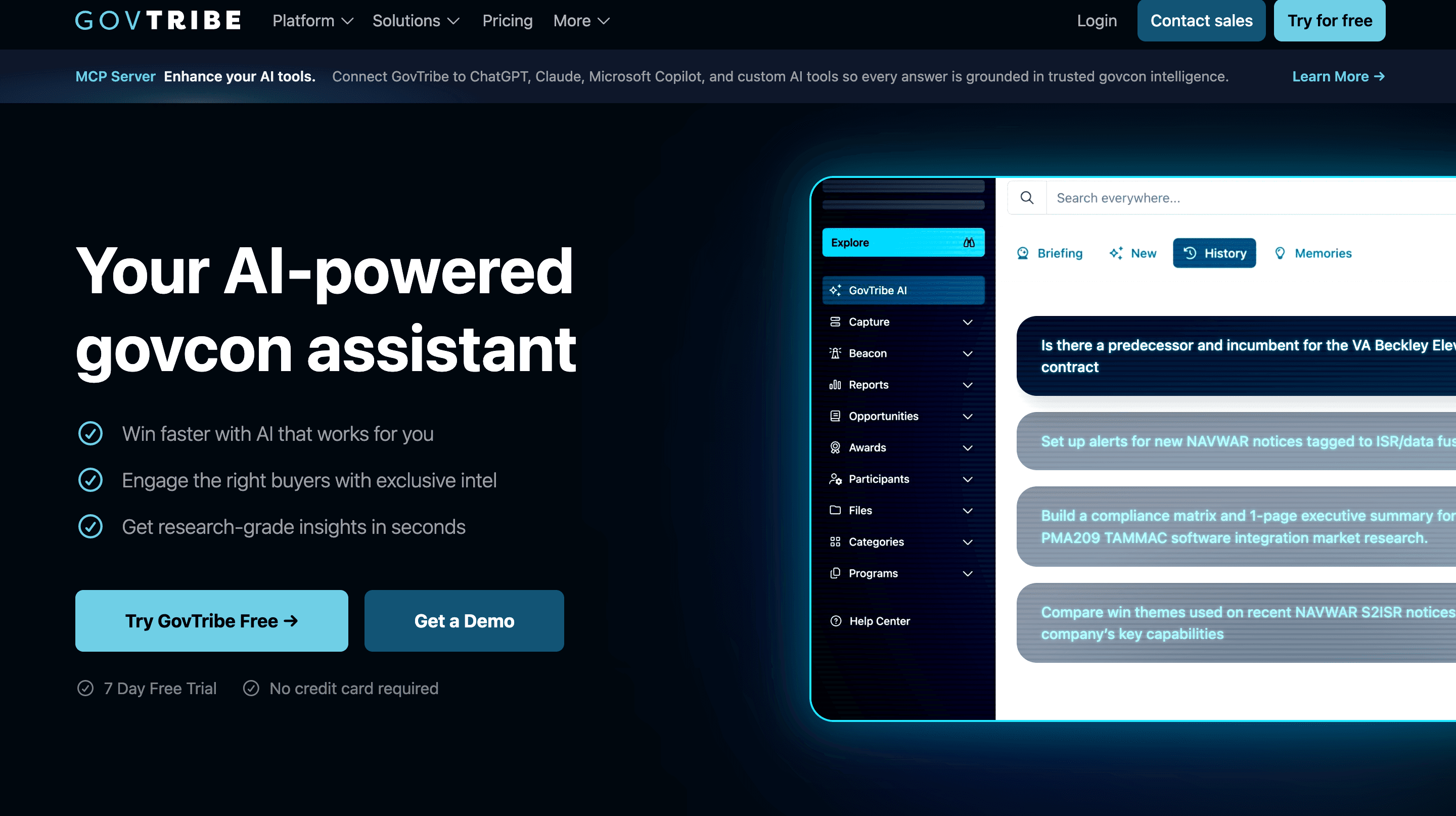
GovTribe
Best for Federal on a BudgetGovTribe was founded in September 2012 by Nate Nash, Jay Hariani, and Marc Vogtman — all former Deloitte and BearingPoint consultants who had worked as government contractors. They built GovTribe to solve their own pain points. In August 2021, GovTribe was acquired by GovExec (backed by Growth Catalyst Partners). In November 2022, it was voted 'Favorite Federal Market Intelligence Tool' by GovBrew readers, capturing 80% of the vote — far ahead of GovWin IQ, Bloomberg Government, and Federal Compass. With plans starting at $1,350/year, it's one of the most accessible platforms in the space.
GovTribe has been making forward-thinking AI investments. They launched GovTribe AI as a research assistant in late 2025, and in February 2026 released the first MCP server built for GovCon — connecting their opportunity data to ChatGPT, Claude, and Copilot with 50+ tools covering agencies, awards, forecasts, grants, and contacts. Their SLED coverage is expanding (~22 states), though their core strength remains federal with 1.2M+ contacts and deep SAM.gov integration.
The main trade-off is clear: GovTribe is a federal-first platform. With plans from $1,350–$5,500/year, it's affordable and well-designed for small to mid-size federal contractors. But for SLED, the gap is significant — GovTribe covers ~22 states while Civic IQ covers 76,000+ agencies across all 50 states. GovTribe also lacks native CRM integrations (Zapier only) and doesn't offer email sequences or outreach tools.
- Strong federal opportunity tracking with deep SAM.gov integration
- 1.2M+ federal contacts and award history
- Built-in pipeline management with capture metrics
- GovTribe AI and first-of-its-kind MCP server for AI tools
- Clean, intuitive UI praised by users
- More affordable than GovWin for federal teams
- Limited SLED coverage (~22 states, still expanding)
- No native CRM integration (Zapier only)
- No email sequences or sales execution tools
- No AI document analysis of meeting transcripts at scale
- Federal-first architecture — SLED data is newer and less mature
vs Civic IQ
GovTribe and Civic IQ serve different markets. GovTribe is strong in federal with 1.2M+ federal contacts; Civic IQ is strong in SLED with 76,000+ agencies and 2.6M+ contacts. Civic IQ also includes built-in sales tools and native CRM integrations that GovTribe doesn't offer. Many teams that sell into both markets use both.
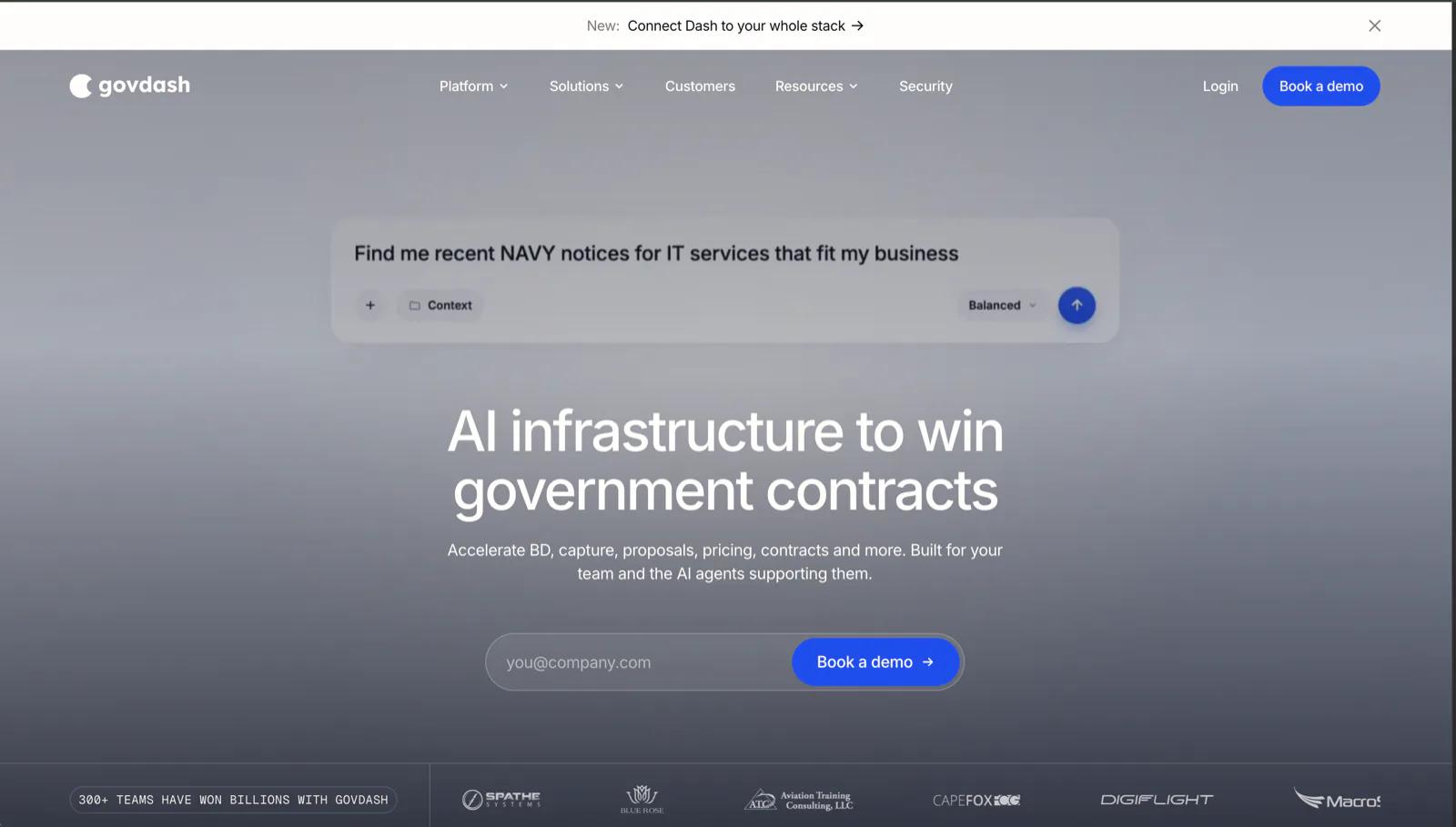
GovDash
Best for AI Proposal WritingGovDash was founded in 2021 by Sean Doherty, Timothy Goltser, and Curtis Mason and went through Y Combinator's Winter 2022 batch. They've raised $40M+ total: a seed round, $10M Series A led by Northzone (May 2024), and $30M Series B led by Mucker Capital and British Columbia Investment Management Corporation (January 2026). Post-Series A, GovDash achieved 16x revenue growth, expanded to nearly 200 customers (including SPATHE Systems, PowerTrain, and Sumaria Systems — top-100 federal contractors), and scaled from 3 to 45+ employees.
The platform goes well beyond proposal writing: automated compliance matrix generation with 95%+ accuracy, cost and labor modeling (GovDash Pricer), capture management (Capture Cloud), and post-award contract management (Contract Cloud). In 2025, GovDash customers won $5 billion+ in contracts, pursuing 3x more opportunities with proposal cycles reduced to 24 hours. They've achieved FedRAMP Moderate Equivalency and expanded into SLED across 50 states, though their AI is still trained primarily on FAR/DFARS federal procurement regulations.
The fundamental difference between GovDash and Civic IQ is the stage of the sales cycle they address. GovDash helps you win after the RFP drops. Civic IQ helps you find opportunities before the RFP drops. GovDash has no contact database; Civic IQ has 2.6M+. Civic IQ has no proposal writing; GovDash's is best-in-class. For teams whose bottleneck is finding opportunities early, Civic IQ is the pick. For teams whose bottleneck is writing winning proposals, GovDash is the pick. Some teams use both.
- Best-in-class AI proposal writing trained on FAR/DFARS
- Automated compliance matrix generation (95%+ accuracy)
- Full capture-to-contract lifecycle in one platform
- Cost and labor modeling (GovDash Pricer)
- FedRAMP Moderate Equivalency for security-conscious teams
- Strong momentum: $5B+ in customer wins, $40M raised
- No contact database — can't find or reach decision-makers
- No pre-RFP signal detection from government documents
- No email sequences or outreach tools
- AI trained primarily on federal regulations, not SLED
- SLED coverage is a recent expansion, less mature
- Salesforce-only CRM integration
vs Civic IQ
GovDash and Civic IQ solve different problems at different stages. Civic IQ finds opportunities 6–18 months before the RFP with 2.6M+ contacts. GovDash helps you write winning proposals after the RFP drops. No overlap in core features — they complement each other well for teams that sell across both stages.
Feature comparison
To see exactly how these platforms stack up feature by feature, here's our side-by-side breakdown across the capabilities that matter most for government sales teams.
| Feature | Civic IQ | GovWin | GovSpend | GovTribe | GovDash |
|---|---|---|---|---|---|
| Pre-RFP signal detection | |||||
| AI document analysis at scale | |||||
| SLED agency coverage | 76,000+ | Broad | Broad | Limited | |
| Contact database | 2.6M+ | ~530K | Spending-linked | Federal | Federal |
| RFP tracking & alerts | |||||
| Spending & purchase data | |||||
| Meeting-derived competitor intelligence | |||||
| Email sequences & outreach | |||||
| CRM integration | Deltek + SF connector | SF + HubSpot | |||
| AI proposal writing | |||||
| Sales pipeline management | |||||
| Federal coverage |
The bottom line: match the tool to the problem
There is no single best government contract intelligence platform. There is the best platform for your specific sales motion, target market, and workflow. A SLED-focused team that needs to find opportunities before RFPs are published has fundamentally different needs than a federal contractor that needs to write compliant proposals faster.
If we had to boil it down: Civic IQ is the strongest option for SLED teams that want to get in early with pre-RFP intelligence, contacts linked to live buying signals, and built-in sales tools. GovWin IQ remains the standard for large federal contractors who value analyst-curated depth. GovSpend is unmatched for historical spending analysis and vendor benchmarking. GovTribe is the best value in federal opportunity tracking. And GovDash is the only platform that turns AI into a proposal-writing machine.
Many of the most effective government sales teams don't pick just one. They pair a pre-RFP intelligence platform with a bid-stage or proposal tool. The important thing isn't which platform you choose — it's making sure you're not still relying on the same manual, reactive approach that worked in 2020 but leaves you competing blind in 2026.
Stop chasing RFPs.
Start shaping them.
Somewhere in the country, an agency is discussing a project you could win. See the signal before your competitors do.
What our customers say
“Civic IQ found us a lead with one of the fastest-growing cities in the US and booked a meeting in our first week working together. City engineer asked us for a proposal that we're sending this week. Really solid lead.”

Connell McLaughlin
CEO, Route Reports
“After implementing Civic IQ, we quickly secured a few extra appointments the team was thrilled. Things are going so well that we're even considering adding another team member to keep up with demand.”

Chris Hines
Ideal Impact