
Board meeting monitoring for 100,000+ agencies, asked in plain English
City councils, school boards, and special districts all discuss budget priorities in public meetings months before anything goes out to bid. This tool turns that agenda and minutes data into a question you can ask Claude or ChatGPT directly.
> Any board meetings this month mentioning EV charging in Colorado?
→ connecting to civic-iq-mcp...
Matches board meeting signals by topic, state, and timeframe
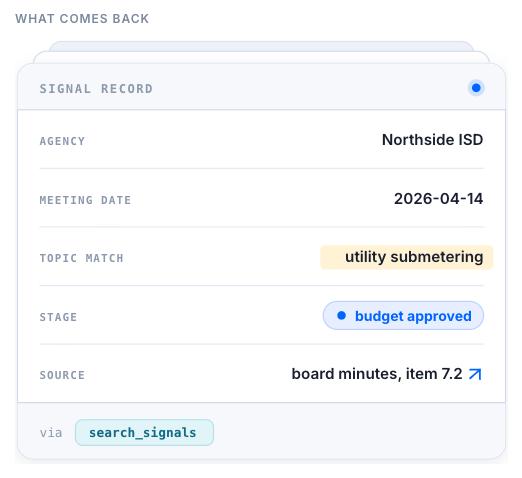
Each result includes the agency, meeting date, and matched keywords
What is public meeting monitoring?
Public agencies debate their spending in the open before they buy anything. A district decides its roofs are failing in a facilities committee, allocates money in a budget session, and instructs procurement to write the specification. All of it in published meetings, months before a solicitation exists.
Public meeting monitoring is the practice of reading those records at scale. Civic IQ collects the agendas, packets, and minutes of 100,000+ agencies, finds the line items that match what you sell, and tells you which stage the agency has reached, so the conversation you have is about their timeline, not your product.
The same feed your team already watches, now queryable directly
This tool is one of several exposed by the Civic IQ MCP server. Connect once and every tool (meetings, spend, contracts) is available in the same chat.
Claude
Add the Civic IQ MCP server as a connector in Claude and ask about an agency, vendor, or category in a normal chat.
ChatGPT
Connect the same server as a custom connector or GPT action to bring agency signals into your existing ChatGPT workflows.
Custom agents
Point any MCP-compatible agent framework at the endpoint to pull structured signal data into your own tools.
How do you query it?
Add the Civic IQ endpoint to your assistant once and meeting signals are available in any chat. Full setup steps for Claude, ChatGPT, and custom agents live on the MCP server hub.
https://beta.mcp.civiciq.com/mcpExample queries teams run against this tool
These reflect the actual filters this tool supports: topic keywords, state or nationwide, agency type, timeframe, and signal stage.
> Which school districts in Florida discussed stormwater or facilities funding recently?
Filters board meeting monitoring by topic, state, and agency type together.
> Show me signals from the last 12 months for K-12 districts only
Combines a timeframe filter with an agency-type filter.
> Which of these are still in early discussion versus budget already approved?
Uses the signal's stage (early discussion, budget approved, or RFP imminent) to prioritize follow-up.
> Any meetings that mention a specific vendor by name?
Useful for account teams tracking a current vendor or a competitor by name in live discussion.
What does it actually cover?
Three things worth knowing before you ask it anything: where the records come from, whose meetings are read, and what the stage labels mean.
Sources
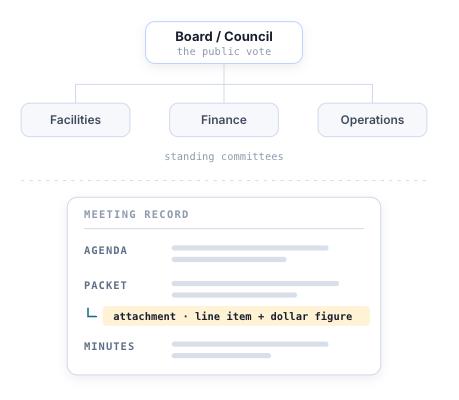
Published agendas, board packets, and approved minutes: the primary record, not a news summary of it. Where an agency posts a packet attachment, the attachment is read too, which is usually where the line item and the dollar figure actually appear.
Agencies
100,000+ state, local, K-12, and higher-education bodies. Full boards and councils, plus the standing committees (facilities, finance, operations) where scope tends to be shaped before it ever reaches a public vote.
Stage labels
Every signal carries one of three labels, describing where the agency is in its own process rather than how promising it looks to you. These are the same labels you see in the results above.
- early discussion
- The need was raised in a meeting. Nothing is funded yet, so this is where you get to shape how the problem is framed.
- budget approved
- Money is allocated but scope is still open. The most useful moment to be in the room.
- RFP imminent
- Procurement is drafting the solicitation. Last chance to influence requirements rather than respond to them.
What can you ask it?
Plain language, the way you would brief a new rep. No query syntax, no tool names.
“Which Ohio districts discussed roof replacement this quarter?”
Matching meeting line items across the state, each labeled by stage.
“What did my accounts talk about last month?”
Recent meeting activity for the agencies you follow, newest first.
“Show me anything at budget-approved stage in my territory.”
Filtered to agencies that have already allocated money in a meeting.
“Which committee raised this, and when does it meet next?”
The source meeting body for a signal, with its recurring schedule.
Where else does this data show up?
FAQ
Public meetings FAQ
Agendas, minutes, and packets are collected as agencies publish them, so a signal is typically available within days of the meeting it came from.
Governing-body meetings across state, local, K-12, and higher-education agencies: full board and council sessions plus the standing committees where scope is usually shaped first.
The full published record where one exists: agenda, attached packet, and minutes. A line item that only appears deep in an attachment still surfaces.
It describes where the agency is in its own process: early discussion means the need was raised, budget approved means money is allocated, and RFP imminent means procurement is drafting.
Yes. Every signal cites the meeting it came from, so you can read the original record before you make a call.
Yes. The MCP server is a different way into the same signal engine your team already uses, not a separate dataset.
See it running on your own accounts
Book time with our team and we'll walk through the Civic IQ MCP server live, using your target agencies as the example.
Book a walkthrough