
K-12 and higher ed buying signals, filtered from 100,000+ agencies
Every tool on the Civic IQ MCP server accepts an agency-type filter, and this page documents its education scope: K-12 school districts, higher education institutions, and community colleges. Filtered this way, the server returns board-meeting signals, vendor spend, contracts, and contacts for education agencies only, timed to academic budget cycles rather than the standard fiscal year.
School boards and university systems run on their own calendars and budget cycles. This tool narrows the full agency set down to education specifically.
> Which K-12 districts are discussing ed-tech budgets this quarter?
→ connecting to civic-iq-mcp...
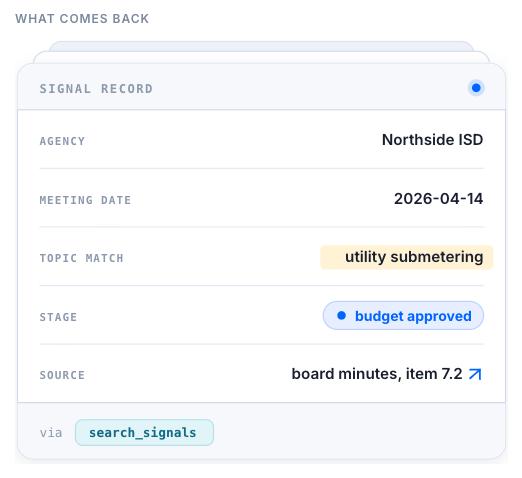
Filters board meeting signals to School/K-12 agency type
Higher ed institutions can be included or queried separately
Same server, scoped to school boards and university systems
Every signal tool on the Civic IQ MCP server accepts an agency-type filter, so SLED-focused teams can scope every query without a separate product.
Claude
Add the Civic IQ MCP server as a connector in Claude and ask about an agency, vendor, or category in a normal chat.
ChatGPT
Connect the same server as a custom connector or GPT action to bring agency signals into your existing ChatGPT workflows.
Custom agents
Point any MCP-compatible agent framework at the endpoint to pull structured signal data into your own tools.
How do you query it?
Every signal tool on the server accepts an agency-type filter, so education-focused teams can scope every query without a separate product. How to connect.
https://beta.mcp.civiciq.com/mcpExample queries teams run against this tool
Vendors selling into K-12 and higher ed use this to track board discussion ahead of academic-year budget cycles.
> Which school districts in our territory discussed safety technology recently?
Filters board meeting monitoring specifically to K-12 agencies.
> What university systems are discussing facilities software?
Scopes the same signal engine to higher ed instead of K-12.
> Any signals under our minimum deal size threshold?
Combines the SLED filter with a dollar-amount floor.
> Which of these districts show existing vendor activity in this category?
Checks against Government Spending MCP for current-vendor context.
What's different about education procurement?
Enough that a city-government playbook mistimes it. Two things shape how education agencies buy.
The academic budget calendar
Most districts run a July-to-June fiscal year: budget development in winter, board adoption in spring, and spending decisions clustered accordingly. A vendor working a calendar-year cycle arrives two quarters late. Signal timing on this page reflects each agency's actual cycle, so a February budget workshop reads as the early-planning moment it is.
Where the signals show up
School board packets, facilities and capital planning discussions, curriculum adoption cycles, technology committee minutes, and boards of trustees for higher ed. The pattern to know: education purchases are board-approved in public, so the decision is visible before the paperwork exists.
Expiring education contracts are the renewal play in this segment: see Contract Renewal MCP.
What can you ask it?
Plain language, the way you would brief a new rep. No query syntax, no tool names.
“Which districts are planning ed-tech budget increases?”
Budget discussion scoped to K-12, staged by how close it is to a purchase.
“What are community colleges in my state discussing about facilities?”
The two-year segment on its own, when that is who your product fits.
“Which universities have technology master plans in progress?”
Higher ed planning documents, before they turn into requirements.
“Who is currently paid for student information systems in Florida districts?”
Chains the education filter with vendor spend: the incumbent, by district.
“Which districts in Texas discussed HVAC replacement this year, and who sits on their facilities committees?”
Chains the K-12 filter and topic with get_contacts.
How is this different from K-12 market intelligence services?
Education-only monitoring services
Ed-specific trackers stop at the district line. Here the same connection also answers who the incumbent vendor is, what contracts are expiring, and who the decision-makers are, and it covers higher ed and the rest of SLED when your territory does.
Conference lists and directory data
Directories tell you districts exist. Signals tell you which ones are actively discussing your category this quarter, which is a different list every quarter.
Waiting for education RFPs
District purchasing is board-driven and therefore telegraphed: the budget workshop and the board vote happen in public, months before any solicitation posts.
Where else does this data show up?
FAQ
K-12 and higher ed FAQ
Yes. Community and technical colleges are covered alongside K-12 districts and four-year institutions, and can be queried as their own group when your product only fits that segment.
Yes. Most education agencies run a July-to-June fiscal year, so budget development, board adoption, and purchasing fall at different points than in city or county government. Signal timing follows each agency's own calendar.
Yes. That is the normal way to use it: scope to K-12 or higher ed, then ask about your category, region, or named accounts in the same question.
SLED stands for state, local, and education: the US public-sector market outside the federal government. This page covers the education slice: K-12 districts, higher ed institutions, and community colleges. The full Civic IQ MCP server covers all of SLED.
No. The MCP server is free to start with a work email, and it answers as your Civic IQ account, so your platform permissions carry over unchanged.
See it running on your own accounts
Book time with our team and we'll walk through the Civic IQ MCP server live, using your target agencies as the example.
Book a walkthrough