
Buying signals from 100,000+ agencies, months before an RFP posts
By the time an RFP is public, most of the budget conversation already happened. This tool surfaces that conversation (the discussion, the stage, the timeline) before RFP.
> Any early signals on energy management budgets this year?
→ connecting to civic-iq-mcp...
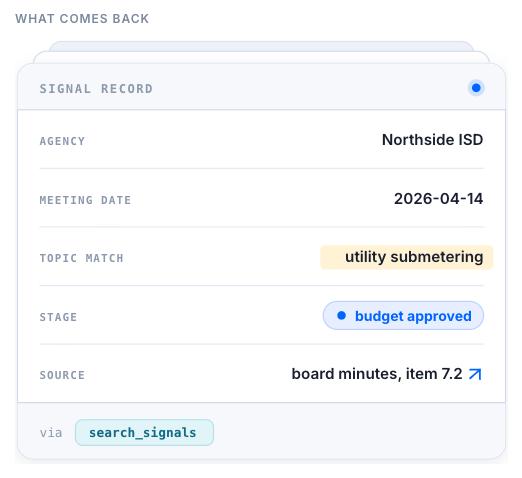
Matches board discussion tied to your topic, ranked by how far along it is
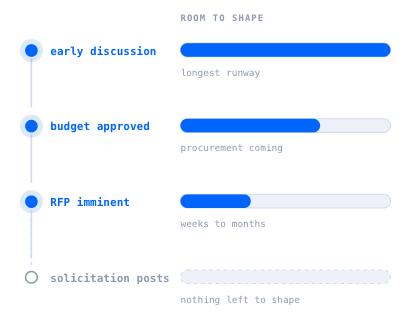
Signals are staged: early discussion, budget approved, or RFP imminent
The same signal that later becomes an RFP, caught earlier
This tool draws on the same board meeting monitoring data as the Public Meetings MCP tool, filtered specifically for early-stage budget and planning discussion.
Claude
Add the Civic IQ MCP server as a connector in Claude and ask about an agency, vendor, or category in a normal chat.
ChatGPT
Connect the same server as a custom connector or GPT action to bring agency signals into your existing ChatGPT workflows.
Custom agents
Point any MCP-compatible agent framework at the endpoint to pull structured signal data into your own tools.
Example queries teams run against this tool
Sales and CS teams use this to build a call list before a category goes competitive.
> What agencies are in early discussion on submetering software?
Surfaces the earliest-stage signals, before budget is even approved.
> Which of our target accounts have shown a signal in the last 6 months?
Filters pre-RFP signals down to a named account list and timeframe.
> Show me only signals where budget has already been approved
Filters to the stage closest to an RFP: the strongest near-term opportunities.
> Are there any signals above a certain dollar threshold?
Uses the minimum dollar amount filter to focus on deal size.
How signals are staged
Three stages, describing how close the agency is to a solicitation in its own words. These are the labels you see in the results above.
- early discussion
- The topic has entered board or committee conversation with no budget attached yet. Longest runway, and the best window to shape requirements before anyone writes them down.
- budget approved
- Funds are allocated or a line item exists. Procurement is coming; the open questions are when, and in what form.
- RFP imminent
- Explicit procurement language: solicitation drafting, timeline votes, going out to bid. A weeks-to-months horizon, and your last chance to influence rather than respond.
What kinds of signals does it catch?
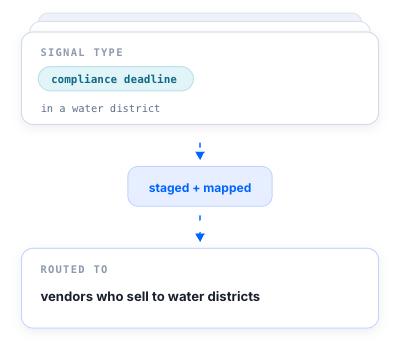
The recurring types are technology assessments and needs analyses, capital improvement plan line items, consultant engagements, budget study sessions, contract renewal discussions, compliance deadlines, pilot program approvals, and leadership transitions. Each is staged and mapped to the vendor categories it affects, so a compliance deadline in a water district reaches the people who sell to water districts.
Full breakdown with real examples: 10 pre-RFP signals every B2G team should track
What can you ask it?
Plain language, the way you would brief a new rep. No query syntax, no tool names.
“Any early energy management signals in the Southeast?”
Signals matching your category and region, staged by procurement proximity.
“What is happening at my named accounts this quarter?”
Filtered to the agencies you already own, so you are not reading a whole territory.
“Show me RFP-imminent signals in water treatment above $500k.”
Stage plus topic plus dollar threshold, for pipeline you can act on this month.
“Which agencies moved from discussion to budget approved since last month?”
Stage changes over a timeframe, the clearest buying-intent trigger there is.
“Which agencies in early discussion on fleet electrification have approved budgets above $250k, and who are the contacts?”
Chains stage, topic, and dollar filters with get_contacts: signal to call list in one prompt.
How is this different from RFP alerts?
Bid boards and RFP alert services
Alerts fire when the solicitation posts, after requirements are written and often after the informal vendor evaluation is already done. These signals arrive 6-18 months earlier, while the outcome is still shapeable.
Historical spend data
Spend records show who won last time; pre-RFP signals show who is about to buy next. They are complements rather than substitutes, and both live on the same MCP connection.
Reading agendas yourself
The signal engine reads and stages meeting documents across all 100,000+ agencies continuously. The manual version of this job does not scale past a handful of accounts, which is why most teams only watch the ones they already know.
Where else does this data show up?
FAQ
Pre-RFP signals FAQ
Typically 6 to 18 months, though it varies by agency and category: a capital project may surface two years out, while a compliance-driven purchase can move from first discussion to solicitation in a single quarter.
Yes, where the agency stated a figure. Signals can be filtered by topic, state, agency type, timeframe, and dollar threshold, so you can exclude anything below your minimum deal size.
Staging reflects the language the agency itself used in the record, not a prediction of what it will do. Agencies do stall, reprioritize, and skip stages, so a stage tells you where the conversation stood at that meeting.
Same data, different cut: Public Meetings MCP searches everything discussed in board meetings; Pre-RFP Signals filters that stream to purchase-intent language and stages each result by how close it is to a solicitation.
Recurring types include technology assessments, capital improvement plan line items, consultant engagements, budget study sessions, contract renewal discussions, compliance deadlines, and pilot approvals, each staged and mapped to vendor categories.
No. The MCP server is free to start with a work email, and it answers as your Civic IQ account, so your platform permissions carry over unchanged.
See it running on your own accounts
Book time with our team and we'll walk through the Civic IQ MCP server live, using your target agencies as the example.
Book a walkthrough