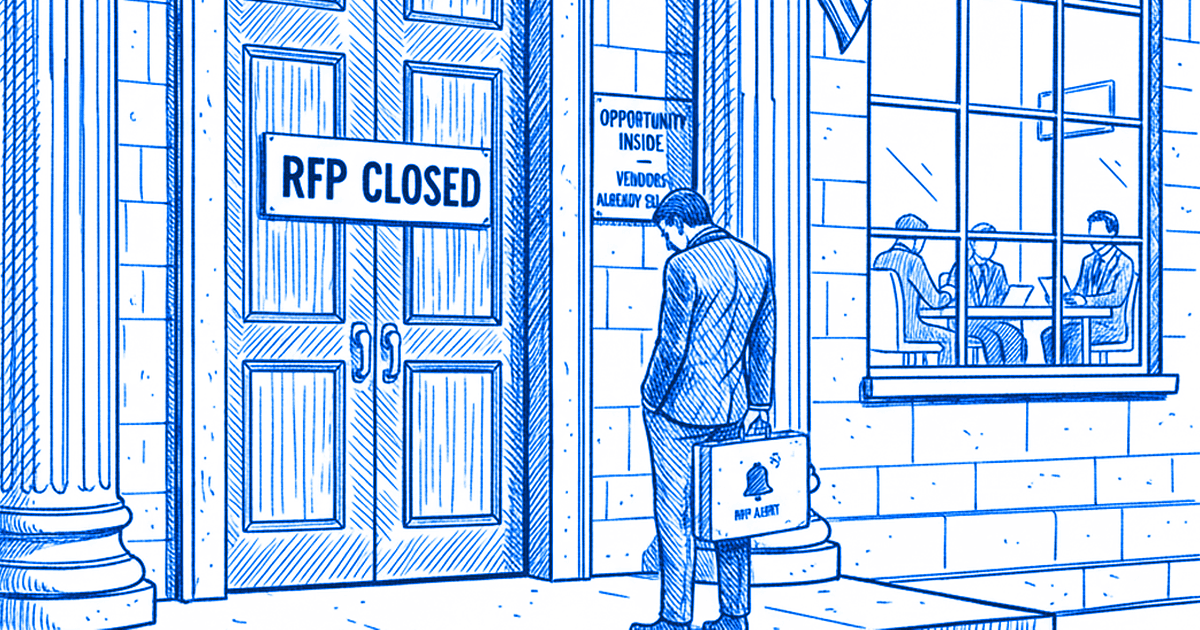
While publicly accessible RFP alerts are a crucial tool for transparency and fostering competition in public procurement, relying solely on them carries hidden risks that can undermine the effectiveness and integrity of the process.
Bid alert platforms are where most vendors start. Civic IQ’s BidNet Direct review looks at one of the biggest of them in detail: what it costs, what its free tier covers, and why a posted alert already arrives late.
Here’s why:
1. Limited Scope and Information
Public RFP alerts often provide only a basic overview of the opportunity, lacking the detailed information necessary for a comprehensive understanding of the project, its full scope, technical specifications, and the broader context.
2. Potential for Bias and Manipulation
The design of the procurement process and specifications, even when publicized, can be subtly tailored to favor certain vendors, or exclude others.
3. Challenges in Assessing the Market and Competition
RFP alerts might not reveal the full picture of the market and competitive landscape, including whether there’s genuine competition or if specific market conditions are being exploited.
4. Risk of Collusion and Bid-Rigging
RFP alerts alone cannot guarantee protection against unethical practices like collusion, where vendors secretly agree to manipulate prices or outcomes, something that’s often difficult to detect from public information alone.
5. Information Asymmetry
Relying solely on RFP alerts creates an uneven playing field, where insiders might have additional context, informal knowledge, or connections that give them an unfair advantage.
6. Difficulty in Detecting Irregularities and Inefficiencies
While some irregularities may be obvious, many nuances and subtle issues in the procurement process can be overlooked without deeper analysis beyond just the initial RFP alert.
7. Lack of Proactive Market Engagement
Depending only on alerts results in a reactive approach. Proactive engagement with the market, suppliers, and experts is critical for informed opportunity design and maintaining a truly competitive environment.
In Summary
Public RFP alerts are essential for transparency, but they represent only one part of a robust procurement process. To mitigate risks and ensure fair, efficient, and ethical outcomes, organizations must go beyond alerts by:
- In-depth market research and analysis: To understand the competitive landscape and identify potential risks and opportunities.
- Careful tender design: To ensure clear, unambiguous specifications and eliminate potential biases.
- Monitoring for red flags and anomalies: Looking for unusual bidding patterns, statements, and behaviors that might indicate collusion or manipulation.
- Robust evaluation processes: Assessing not just price, but also quality, experience, and the overall value proposition.
- Ongoing transparency and accountability throughout the entire contract lifecycle: This includes publishing relevant information, allowing for feedback, and ensuring compliance with regulations.
How Civic IQ Helps
At Civic IQ, we don’t stop at scanning public alerts, we surface the signals that come before an RFP ever lands. Our AI continuously analyzes public meetings, budgets, staffing changes, grant allocations, and agency activity to spot early intent. That means your team knows where opportunities are emerging months in advance, can shape outreach before specifications are locked, and goes into every bid cycle with a competitive edge. By transforming fragmented data into actionable intelligence, Civic IQ helps you move first, engage smarter, and win more.
Ready to stay ahead of the curve? Book a demo with us today and see how Civic IQ turns early signals into real results.